

For months, I’ve had a seemingly endless backlog of stories to share from our trip to Europe. There was always another city! Another museum! Another train ride! Another set of pictures waiting to be sorted!
And now we’ve reached the penultimate recap post.
One of our final adventures was a day trip from Cardiff, Wales to Bristol, England.
Bristol is an incredibly easy city to visit from Cardiff by train. You can get between the two cities in about an hour, so it’s reasonable to head over in the morning, spend a full day exploring, and be back in Cardiff in time for bed.
And, as it turns out, there’s a LOT of cool things to cram into one day in Bristol.
We saw churches, an enormous ship, Banksy street art, beautiful Georgian houses, a famous suspension bridge, a camera obscura, a free museum, and—somewhat unexpectedly—came across a VERY slippery rock.
Our One-Day Bristol Itinerary
If you’re looking for the quick version, this was our route:
- Bristol Temple Meads
- Temple Church
- M Shed and the Bristol harbour
- SS Great Britain
- Banksy’s Girl with a Pierced Eardrum
- Royal York Crescent in Clifton
- Clifton Suspension Bridge
- Clifton Rock Slide
- Clifton Observatory and Giant’s Cave
- Bristol Cathedral
- Banksy’s Well Hung Lover
- Bristol Museum & Art Gallery (with Banksy’s Paint Pot Angel)
- Palm Temple
- A few more Banksy murals: Rose on a Mousetrap and Mild Mild West
This is a fairly ambitious Bristol itinerary. We did a lot of walking and Bristol is hilly—especially once you start heading toward Clifton. But, crucially, this route didn’t involve backtracking.
If you’re looking for a more leisurely day, I’d likely suggest trimming several things from the list above, but more on that later!
Arriving at Bristol Temple Meads

We took the train from Cardiff Central and arrived at Bristol Temple Meads. This station opened in 1840 as the western terminus of the Great Western Railway.
It was originally designed by Isambard Kingdom Brunel, a famous engineer. (His name will show up a few times, so stay tuned.)
It was an especially beautiful train station!
Temple Church
From the station, we walked to Temple Church.
I had read that the church would be open from 10 am–4 pm… but for some reason, it was not open the day we visited (even though the sign said it was open). Sigh.


Even without being able to go inside, I’d say this was a worthwhile stop because you can see lots from the outside.
Temple Church has roots going back to the Knights Templar, who established a church on this site in the 12th century. The original church was round (apparently a characteristic design for Templar churches?) and most of the ruins we see today date from later centuries.
The bell tower was interesting. It started leaning while it was still under construction and was noticeably crooked by the time it was completed around 1460. I’m mostly impressed it’s stayed standing all these years, especially since the church was badly damaged during the WWII “Bristol Blitz” in November 1940.
I would have loved to get inside, but the exterior was still impressive and it’s an easy stop on the walk from Temple Meads toward the harbour.
M Shed and Bristol’s Harbour
Next, we made our way to the waterfront and M Shed, a free museum devoted to the history of Bristol.
(Free museums were becoming a theme during this portion of our trip! We’d already had great experiences at both Big Pit and St Fagans.)

There are enormous historic cranes outside M Shed, ships in the harbour, and all sorts of industrial-looking bits and pieces that make this area fun to wander around.

Our main rationale for going to the M Shed was to see our first Banksy.
(Banksy’s true identity has famously been kept under wraps, but he is believed to be from Bristol and got his start in the city’s graffiti scene. Bristol is still home to a number of his best-known pieces, so if you enjoy street art, there are plenty of opportunities to encounter Banksy as you walk around the city!)
Banksy’s Grim Reaper

Banksy originally painted Grim Reaper directly onto the side of Thekla, a ship moored in Bristol Harbour, in 2003.
Because the artwork was so close to the water, years of exposure to the elements were causing it to break down. In 2014, the entire section of steel containing the artwork was removed from the ship, conserved, and eventually put on display inside M Shed.
Obviously it’s not quite as… organic as stumbling across a Banksy on the side of a building. But it was still very fun to see.
The Matthew

I had also really wanted to see The Matthew, a reconstruction of the ship John Cabot sailed from Bristol to Newfoundland in 1497.
Newfoundland!! It’s practically our part of the world! (And the famous Cabot Trail in Nova Scotia is named after this explorer.)
Visitors can normally go aboard the reconstructed ship when it’s in Bristol.
Except it wasn’t in the harbour on the day we were visiting.
Unlike a lot of historical replicas, The Matthew actually sails—which is very cool… unless you happen to show up on the day when you want to see it and it’s out sailing.

We also saw the tracks and steam train for the Bristol Harbour Railway, which runs along the quayside between M Shed and SS Great Britain.
SS Great Britain
From M Shed, we kept walking along the harbour toward SS Great Britain.


This was another iconic Bristol attraction we chose to admire from afar.
SS Great Britain was designed by Brunel (remember him from the train station?) and launched in Bristol in 1843. At the time, it was the largest ship in the world and was groundbreaking for combining an iron hull with screw-propeller technology (whatever that means).
You can pay to tour the ship and museum, and it looked very cool, but I don’t think the kids would have been overly impressed. Plus, it’s hard to beat Viking ships at Roskilde and the Vasa in Stockholm!
Banksy’s Girl with a Pierced Eardrum
We did, however, make time for another Banksy.

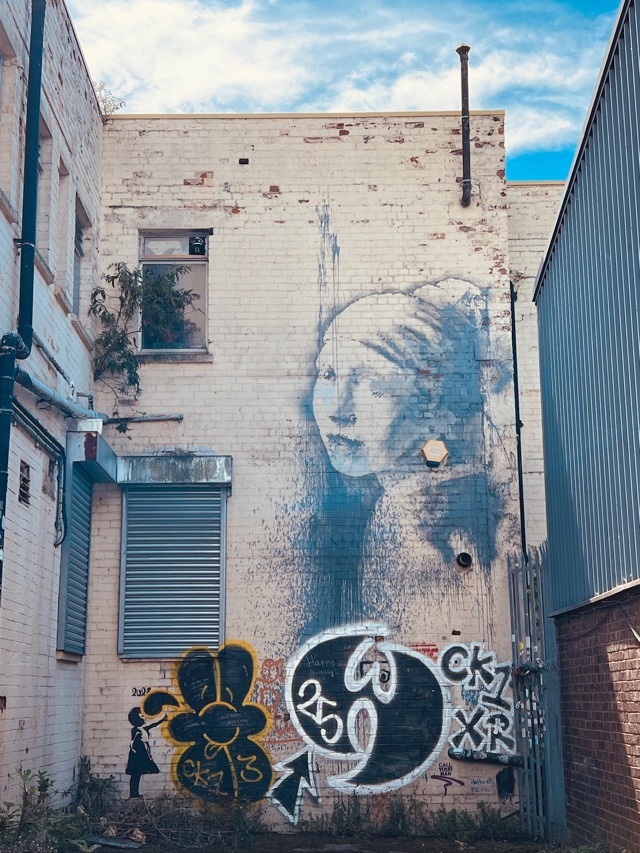
Girl with a Pierced Eardrum is Banksy’s play on Vermeer’s Girl with a Pearl Earring.
Instead of a pearl earring, it’s a security alarm attached to the side of the building!
Climbing Up to Clifton

We walked by the marina, and then we started climbing.
Bristol has some serious HILLS.


Our next destination was Clifton, and along the way we stopped at Royal York Crescent.
This was an enormous sweeping row of white houses I had read about and wanted to see, but I didn’t plan to navigate there directly (figuring the kids wouldn’t care). Turns out, our route happened to lead us right by these iconic houses.
Royal York Crescent has 46 houses and construction began back in the late 1700s. The project stalled after a financial crash and ended up taking decades to fully complete. It’s been described as the “longest terrace in Europe.” It’s beautiful and very exclusive (read: incredibly expensive).

Because of its elevated location, you get awesome views over Bristol.
Clifton Suspension Bridge
From there, we headed to Bristol’s most recognizable landmark: the Clifton Suspension Bridge.

Brunel (there’s his name again!) designed the bridge when he was still a young engineer. He actually won a competition to design it while he was in his 20s, but construction took decades—I’m sensing a pattern here—and the bridge didn’t open until 1864, several years after Brunel’s death.

The bridge spans the Avon Gorge and the views are fantastic.


We found a spot nearby to enjoy our picnic lunch in the shade. While we were eating, Indy spotted kids off in the distance sliding down… a rock?
Were we seeing things right??
Clifton Rock Slide: Yes, This Is Actually a Thing
At first glance, the rock near Clifton Observatory looks like… a rock.
But it’s been polished smooth by generations of people sliding down it and is locally known as the Clifton Rock Slide or Slidey Rock.
Indy scrambled up to the top (not easy), sat on a shiny part, and then zoomed down that rock at a speed NONE of us had anticipated.


Indy is generally up for physical adventures, but once was enough for him. It all happened so fast and he picked up speed so quickly and he was hurtling down a steep rock toward MORE rocks AND I WAS SO RELIEVED WE DIDN’T NEED EMERGENCY DENTAL SURGERY. It doesn’t look particularly dramatic from the pictures, but it was quite terrifying.
As my grandmother would have said: All’s well that ends well. She would also have said he didn’t get hurt More by good luck than good management. And she would have been right on both counts!
It’s free entertainment, but be mindful: depending on what material you’re wearing and the weather… you might get a lot more excitement than anticipated.
Clifton Observatory, Camera Obscura, and Giant’s Cave
Right beside the “rock slide” is Clifton Observatory.


This ended up being one of my favourite stops of the day.
John stayed outside with our backpack, so it was just the kids and me who went in.
We paid a few pounds each to access both the Camera Obscura and Giant’s Cave.
I LOVE a camera obscura. (We have one within an hour’s drive of our house in Nova Scotia.)


The one at Clifton Observatory has been operating since 1828 and is one of only a handful of working camera obscuras in the UK. You can rotate the mechanism to get a 360-degree view of the surrounding area projected onto a viewing table.
So fun!
There were a lot of interesting-looking plaques on the way up to the camera obscura. The kids were not keen to stop, but I get the sense you could learn a lot about how camera obscuras work and read a whole lot more about our favourite engineer, Brunel!


Then we headed down to Giant’s Cave. According to local folklore, Bristol used to be home to two giants: Goram and Ghyston and their home was this cave.
A bit less mythically exciting is the fact this cave was part of a Roman chapel in 305 AD. Fast forward to the 17th century, and legend says it was home to a man living in religious solitude. And in the 19th century, the current building was converted from a snuff mill to an observatory. In the 1830s, the owner dug a shaft down to join up with the cave.
The resulting tunnel is 200 feet long, and the cave opens up to the cliff face (250 feet above the Gorge and 90 feet from the top of the cliff).
Here’s my two cents about the experience: if you’re claustrophobic, you will not enjoy this! At all!
You get to the cave by going down about 130 steps through a very narrow tunnel that eventually opens up into the side of a cliff along the Avon Gorge.

It’s cramped and the steps can be slippery.

You have to wear a hard hat and I strongly recommend ACTUALLY WEARING THE HARD HAT.
I am fairly short and I felt like I was crouching for most of the way—and I still hit my head repeatedly.

The view at the end is cool, though I’m not convinced it’s any more spectacular than the many free views you get around Clifton.
But it was inexpensive, quirky, and something the kids and I all enjoyed, so I’d say it’s totally worth it if you’re physically mobile. (Remember to wear the hard hat!!)
You Don’t Need Planning Permission to Build Castles in the Sky
Then it was time for more Banksy.


We stopped by the wordy: You Don’t Need Planning Permission to Build Castles in the Sky by Banksy.
(This piece is tucked away on Lower Lamb Street behind Bristol Central Library.)
Bristol Cathedral

Next up: Bristol Cathedral.
The cathedral started life as an Augustinian abbey and parts of the medieval monastery are still standing today. (Admission is free.)
The inside was beautiful.


There’s also a cafe inside the cathedral run by Pinkmans Bakery.
I had made a mental note about this because Pinkmans has been included in The Sunday Times’ Top 25 Bakeries in the UK.
We arrived right before closing, so I didn’t get to test this rating out for myself.
Directly across College Green from the cathedral is the huge curved building I had labelled in my notes as “I think this is City Hall?”


It is indeed Bristol City Hall.
Good job, past me.
Banksy’s Well Hung Lover

From there we saw another of Bristol’s best-known Banksy murals: Well Hung Lover.
(If you’re travelling with kiddos, the title may lead to some follow-up questions… consider yourself warned.)
The paintball stains are not part of the original, but I think most Banksy graffiti gets defaced fairly quickly, and there’s no attempt to “clean it up.”
Bristol Museum & Art Gallery

Next we popped into Bristol Museum & Art Gallery.
Entry is free—my favourite price!—which makes this an easy stop even if you don’t have time for a proper museum visit.

We were mostly there to see Banksy’s Paint Pot Angel.
The statue was part of Banksy’s 2009 takeover of the museum, Banksy vs Bristol Museum, and was left with the museum as a permanent piece.

While we were there, we also saw Alfred the Gorilla, one of the museum’s most famous residents (I know there was a big writeup about his significance to the city, but now I can’t remember any of the details), and a historic Romany wagon. An entire family would live in a wagon like this. For decades!

Because of how little time we had in Bristol, this was more of a thirty-minute “we’re here, let’s look at several weird and wonderful things” kind of visit.
The Stained-Glass Snail Shell Thing
I took pictures of a colourful structure on the University of Bristol campus and apparently my sophisticated description of it was something along the lines of: “stained-glass snail shell thing?”
When I was writing this post, I Googled that exact search string and it didn’t take much sleuthing to find the answer.


It’s called Palm Temple and was created by British artist Luke Jerram.
I still think “stained-glass snail shell thing” is a reasonable description.

Rose on a Mousetrap
By this point we had seen quite a few Banksy pieces… and decided we might as well keep going.

We trekked out to see Rose on a Mousetrap, an early Banksy work on Thomas Street North.
This one was more off the beaten path.
Unless you’re particularly interested in Banksy or trying to see as many pieces as possible, I don’t think I’d make a special trip for it. (There are much easier Banksy works to incorporate into a one-day Bristol itinerary.)
But it worked for us, and I was happy to have seen it.


Mild Mild West
Our final Banksy encounter of the day was walking to see Mild Mild West, which was the first-recorded major piece of street art created by Banksy.


The piece dates from 1999 and shows a teddy bear throwing a Molotov cocktail at riot police.
At this point in the day we planned to go back to a cool-looking Italian place for supper, but there was a giant gas leak and a major portion of the city was shut down.


Streets were cordoned off, and there were police and first responders EVERYWHERE.
So we went to the train station—making a tiny detour back to Temple Church JUST in case it was now open… it wasn’t—about an hour early and made do with grocery-store sandwiches.
It wasn’t quite the ending to the day we had planned, but I’m glad it didn’t happen earlier and completely throw off our itinerary AND I’m thankful there were no injuries or property damage because of the leak.
Is Bristol Worth Visiting for One Day?
Absolutely.
Bristol felt different from almost anywhere else we visited on our trip.
There’s maritime history and impressive engineering (loved the Clifton Bridge) and grand Georgian architecture and quirky caves and street art and free museums!
We packed in a LOT.
If I were planning one day in Bristol again, I’d prioritize the harbour and M Shed, the Suspension Bridge, Clifton Observatory, Bristol Cathedral (and I’d make time to try Pinkmans), and a handful of the easiest-to-reach Banksy pieces. And I would definitely check whether The Matthew was going to be in port.
(I’d only trek farther afield for Rose on a Mousetrap if seeing Banksy was a major priority.)
A Few Things We Didn’t Do in Bristol
Despite covering an impressive amount of ground, there were lots of things we didn’t manage to squeeze into our one day in Bristol.
We only saw Brunel’s SS Great Britain from outside but didn’t pay to tour the ship.
We also skipped Cabot Tower, which—in retrospect—would have been particularly fitting after my disappointment about missing The Matthew, since the tower commemorates John Cabot’s voyage. But… I’d heard mixed reviews about it and, if we had stopped there, we would have missed getting to see Bristol Cathedral because of closing times. And the main draw of the tower is to climb it and we had already done a lot of climbing. So no real regrets about skipping this, but it is a noteworthy stop.
Other popular Bristol attractions we didn’t get to include were St Nicholas Market, Bristol’s historic indoor market, and St Mary Redcliffe Church, one of the city’s most impressive Gothic buildings.
Visiting Bristol With Kids
Bristol worked well with kids our ages. Plus, our kids are used to days with a lot of walking.
I feel like there was almost always something interesting around the next corner: street art, ships, a cave… a dangerous rock to hurtle down. And the fact that so many of our stops were free was also a major bonus.
But be prepared to walk a lot. And climb.
And then climb some more.
It is very hilly. While it would be doable with a stroller, getting to Clifton with small kids without using public transit would be tough.
More From Cardiff and South Wales
If you’re using Cardiff as a base, we found plenty of other great things to do in the area:
- A Day in Cardiff: Penarth Pier, Cardiff Bay + City Center
- Visiting St Fagans in Cardiff: The UK’s Best “Free Day Out”
- An Adventure in Wales: Visiting Big Pit National Coal Museum
- Cardiff Catchall: Roath Park, National Museum Cardiff + Time with Rachel
Your turn.
- Have you ever seen a camera obscura?
- What are your feelings on street art?
Discover more from The Optimistic Musings of a Pessimist
Subscribe to get the latest posts sent to your email.


Loving the Banksy love 🙂
I have always been drawn to Banksy art, so it was very cool to see things in his “native” space and get a feeling for where he got his start with such iconic street art.
The Banksy appearances look great.
I have been to Bristol a couple of years ago for a conference and also saw most of the sights that you mentioned (and the conference dinner was in the large hall of the Bristol museum).
But I was surprised not to see any Gromit figures on your photos. Maybe they have been removed, or maybe they did not spike your interest. (Wallace and Gromit; Shaun the Sheep and other Aardman animations are always very popular in our house.)
I DID see Wallace and Gromit things at M-Shed. We aren’t big Wallace and Gromit (or any Aardman animation) fans—no reason why not, just I’ve never watched them and the kids haven’t been drawn to them. But you are absolutely right that there is a presence in Bristol. I noticed it, but it didn’t make an impact on my psyche because it’s not something I’m overly familiar with, so I really appreciate you reminding me because I bet that’s a major highlight for fans of these animations!!!
This looks awesome! What an interesting city. I love street art, and have definitely heard of Banksy. Just out of curiosity, what things did your kids like best- the museums, the churches, the art? Did they ever get tired of looking at “old” things, or do you feel like they appreciated it all?
Hmm. They liked the street art the best, I would say.
They also like the suspension bridge.
I think the kids were troopers for the most part. They never want to stay in a museum any longer than necessary, but I feel like they appreciate it all in their own way. Some of it is more fun in the moment (or tickles a particular interest of theirs/has a pop-culture reference). So I think some of the appreciation will happen later in life when they see certain things in other contexts. Like, for instance, if they see Banksy’s elsewhere, I suspect they will remember the trip to Bristol very clearly!
I lived in Bristol for almost 30 years (I’m now in Utah) and I had never seen, or even heard of, Temple Church!
That’s hilarious!
You’ll have to let me know what the interior is like if you happen to visit the city again during open hours 😉
I’ve never understood what a camera obscura is. I thought it was some sort of early device that helped Vermeer make his paintings so accurate, not what appears to be a distorting telescope. Guess I’ll have to do some studying on this.
The first time I heard of Banksy was in Israel. Can’t remember what the painting was but do remember it was in Bethlehem, under Palestinian rule (PA=Palestinian Authority) and our Israeli tour guide was not allowed into Bethlehem. This was 2016.
You saw SO MANY INTERESTING THINGS in Bristol in ONE DAY!! That would be too much for my simple mind, something like too much cake.
Now I will go read about Banksy vs. Bristol Museum. Thank you for the tour, the link, and the new topic to learn about.
I don’t pretend to completely understand how camera obscuras work, but they are very cool! I love that it’s not just a static picture, but it’s almost like a video recording of what’s happening… somewhere else! And it’s old “technology” which makes it even cooler.
We packed a lot into a day, but I may never be back to Bristol so I feel very satisfied with the level of things we got to see/do.
You packed so much into your bristol day! I knew you did a lot of walking when you told me after but oh wow that is a LOT of walking!
Sorry you didn’t get to have some bristol dinner, the food in bristol is great. It is a very cool city… but every time I go I’m reminded how much I’m a quiet suburbs girl. It’s fun for a day!
It was a lot. I would NOT recommend following this exact itinerary with your kids at their current ages.
It was a bit of a bummer to not get proper local food BUT, I’m more thankful no one was hurt and that the gas leak happened at the end of the day and didn’t disrupt all our plans.
Very cool! You packed in so much in a day. & That rock is a menace.
I spent a week in Bristol last summer and it was the perfect city for a break: plenty of things to see & do there and many places around (Cardiff, Bath, Costwolds, the Bristol Channel, Gloucester…) for day trips. Awesome that you spotlight the little gems on your big European adventure 🙂
If we’d had one more weekend in Cardiff, we likely would have gone to Bath as well! It was a toss-up between the two cities and it felt like the kids would get a bit more out of Bristol, but Bath is on my UK bucket list for sure.
I grew up near Bristol! How fun 🙂 I remember several adventures on the rockslide!
It looked fun but I could tell it really took Indy by surprise. He was FLYING. And I was relieved he had zero interest in trying it again. Doing it once—and emerging unscathed—was enough!
I will be back next summer to visit friends/family. I will take pics if I can get inside.
I have never seen Bristol on one of my travel itineraries but you made me feel like I need to go there.