

We had a fairly tight turnaround after getting to Cardiff: we arrived Wednesday evening and headed off early Sunday morning for our last travel-heavy adventures (John and Belle to Paris/Amsterdam; Indy and me to Edinburgh—recaps here and here).
But… before we left for those escapades, we managed to fit in a very fun day trip to the Big Pit National Coal Museum with blogger and adventurer extraordinaire, Rachel, and her son, Ezra.
We were treated to a proper Welsh day: rain, wind, sun, back to rain, then some more sun. The only thing missing was hail (though when I checked the weather forecast in the morning, it did mention hail as a possibility).
The weather definitely runs the gamut here!
I know I went to a coal mine when I was a small child and came away with a little piece of coal (I have no idea where it is and I can’t remember a single thing about the experience). So when Rachel suggested we make time to visit Big Pit, I jumped on board with that idea. Especially since coal mining had a huge impact on the development of both the economy and culture of Wales.
From the late 1700s onward, coalfields in southern Wales helped power the Industrial Revolution. Welsh coal fuelled steamships, railways, factories, and homes across Britain and around the world. (Apparently, the boilers on the Titanic were designed specifically to run on Welsh coal.)
Mining communities popped up all around the country, and for generations these coal mines shaped daily life. By the early twentieth century, coal production reached its peak, but then technology advanced, demand for coal changed, other energy sources came into vogue, and health and safety regulations became more stringent (a good thing!!). Mines became increasingly mechanized and eventually most were closed.
I was surprised to learn that some people do still use coal as a fuel source, but today’s coal is mostly imported from China. Where, sadly, there are still incredibly deadly mining disasters.
Since shutting down coal production, Big Pit has become one of the main sites in the UK to learn about the mining industry in a hands-on capacity.
The museum is spread across a number of original buildings, each packed with exhibits that cover all sorts of different aspects of mining life.
Entrance to the main museum exhibits is free, but you can buy tickets to go on an underground tour of the mine.


Rachel suggested we opt for the full experience, and I’m so glad we did. The mine shaft goes 90 metres (~300 feet) below ground which is actually quite shallow by coal-mining standards.
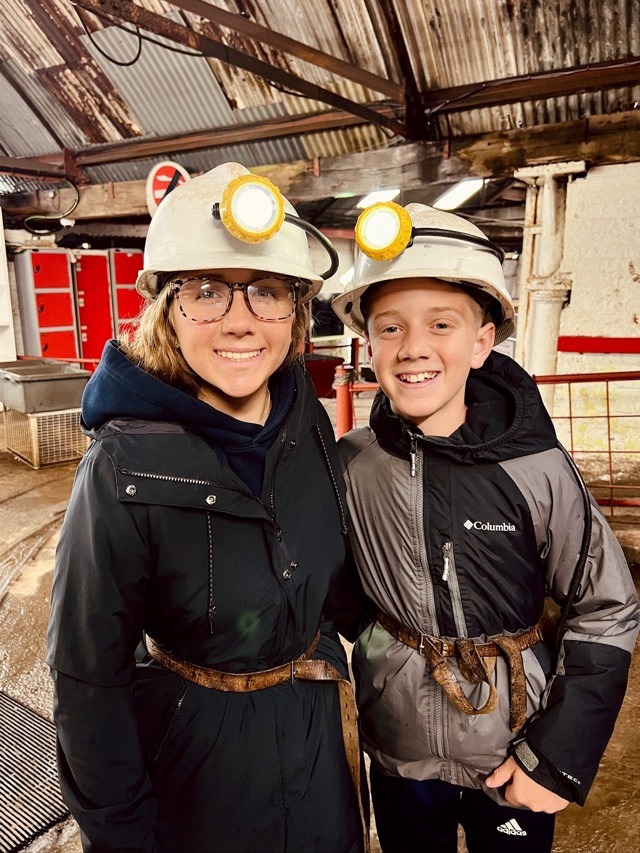
Before heading down, we had to get kitted out with safety equipment. We won’t be featured in any fashion magazines, but when one member of our group accidentally walked into a low wooden beam, those helmets suddenly seemed very practical, if not stylish!


Sibling selfie!


One of the tour guides took a group photo before we stowed our phones away (they weren’t allowed down in the mine).

Our tour guide was fantastic: very knowledgeable, engaging, and a former miner himself. His thick Welsh accent added to the experience, though admittedly I couldn’t understand absolutely everything he said. It was THICK.
He shared stories about daily life underground, the work carried out by women and children during the industry’s early years (I couldn’t help but think that their work in the mines sounded less onerous than their subsequent homemaking responsibilities), and the horses that spent up to 50 consecutive weeks below ground. It was both fascinating and heartbreaking.
He also explained how mining practices evolved over time, with new technologies and stricter safety procedures making the work considerably safer. That said, when things go wrong in mines they tend to go VERY wrong.

Our guide mentioned the origin of the phrase “canary in the coal mine,” and we made a point of visiting the canaries when we emerged from underground.

There are all sorts of exhibits to explore, and since most of them are indoors, the ever-changing Welsh weather didn’t dampen our enthusiasm.


I took a picture of the same coal carts when we walked by them on our way to eat our picnic lunch (they had space to eat inside, thankfully, since the weather was not inspiring)…

And then again half an hour later, blue sky!

One section focused on mining disasters, rescue efforts, and the risks miners faced every time they went underground. Combined with the underground tour, it gave us a good sense of what life was like for the people who worked in coal mines.
I must have said to Rachel a dozen times: I cannot imagine living in this time! The men, yes, but the women, too. What a hard time to be alive. I think the guide said the average lifespan of a miner was 45.


There are lots of spots where you can touch and feel things which is always a big hit with kids!


The locker room was probably my favourite part of the museum. Each miner had two lockers: one for his filthy work clothes and one for clean clothes. At the end of a shift, he’d take off his filthy clothing, shower, and then change into the clean clothes he’d left in his clean locker before heading home. It sounds simple, but this system dramatically improved family life. Before baths became common, miners would go home covered in coal dust, leaving their wives with the enormous task of washing heavily soiled clothes.
Another reason this was so important was that when women had an excess of dirty clothes to wash, it meant their homes basically perpetually had scalding water sitting in wash basins. Horrifically, accidents involving children getting burned on this hot water were incredibly common, and doctors reportedly treated more injuries suffered by miners’ wives and children than miners themselves! Crazy, right?


This display case had hand flaps where you’d stick your hands inside and by feeling the item, try to figure out what you were feeling. The boys were big fans.

This was a demonstration of what a miner’s home might look like.


Each of these coal carts weighed the same but had different mechanisms for movement (over wooden rails, over iron rails, and over solid ground) so you could get a sense of the efficiency of different movement mechanisms.

Indy came across this giant statue and said, I can look up to this guy. Haha.


Indy bought a key chain made out of a piece of coal and that was all we were talked into buying in the gift shop, but I thought this little hanging sign could be repurposed as a cute Christmas ornament!

A huge thanks to Rachel for driving us to Big Pit and giving us the opportunity to try such an authentic Welsh experience.
Your turn.
- Have you ever been down inside a coal mine?
- What homemaking task are you most thankful to have modernized technology to tackle? I pick laundry!
Discover more from The Optimistic Musings of a Pessimist
Subscribe to get the latest posts sent to your email.


Why yes I have toured a coal mine! I went to one in Beckley West Virginia in April. It was fascinating but sad. I don’t think they had anything as advanced as the clean and dirty lockers.
Having to do old school laundry is pretty much at the top of the list. Old school cooking is also high up there. I have my great-grandmother’s Fannie Farmer cookbook from 1910, which starts out by explaining how to build a fire to heat the stove. The recipes are all very short, but have ominous details about butchering meat and other small details that we take for granted today. I am so thankful to be alive in this era and not in any other.
Agreed: fascinating and so sad.
I’m chuckling over “ominous details about butchering meat.” NO THANKS! Laundry and cooking are a big fat NO for me. Also, unmedicated births (would have been especially horrible since I needed two C-sections… chances are, I would have died in childbirth with Belle in previous generations.)
My maternal grandfather was a coalminer, in Yorkshire. My aunt married a Welsh miner who then transferred over to Yorkshire.
Pit tokens (handed in as the men went underground, retrieved when they came back up thereby acting as a roll call in case of disaster), Davey lamps and filthy towels *after* showers were all discussed in my family home when I was a child.
I think it’s easy to forget now how hard a life it was and how much it cost those involved.
Yes, Big Pit has a huge display of pit tokens! Such a practical way to keep track of the men, and obviously heartbreaking that it was in place in case of a disaster. They said that when miners retired their pit tokens became cherished heirlooms. Yes to the lamps. SO fascinating and the miner said more than anything in the world, Davey lamps have probably saved the most lives.
That’s so fun that you got to go there. That is a place that we had on our kist when I was there but we didn’t get a chance. It looks like a very cool experience! I went to a silver mine in Bolivia and it was very impactful. Of course they talked a lot about the deaths which were a staggeringly high number!
It was VERY cool and so well laid out. I love a good plaque and this was overflowing with them 🙂
Running water and indoor toilets first, followed by laundry!
I don’t think I’ve been in a mine, but my husband took kids on a tour of a ( copper? Iron?) mine in the UP of Michigan. I don’t think I could do a mine tour now- I’ve gotten a little claustrophobia in my old age. Young me would have jumped at the chance.
This Wales experience is very cool- thanks for showing us!
Oh I do love running water. And heated water. Imagine having to boil any hot water you had in your house.
I’m not generally claustrophobic and this was quite open, but I think working down there in the dark and damp with only candlelight would have been OPPRESSIVE. Especially doing day after day for years.
It must have been really interesting! I went to an open pit diamond mine museum in Kimberly, South Africa when I was young (7?8?), but sadly remember very little.
I had to smile at the photo of all of you in your warm tops and jackets, and then Rachel’s son in a t-shirt! He is clearly Welsh and used to the changeable weather.
Ha! Yes, Rachel mentioned than when he was young she was worried about him getting overheated, so he’s become well-adjusted to Welsh weather.
I have definitely been glad to have my coat, but the last few days have been hot and lovely here. (Back to rain tomorrow, I think!)
Yep, my home town is the place Birchie visited. It’s a difficult history. My grandfather was a coal miner and there are certainly complicated feeling about it.
I felt like Big Pit really did a great job of discussing the industry from a whole range of angles which I really appreciated; like you say, it’s complicated.
No, I’ve never visited a coal mine. It sounds like an incredibly difficult life. A good reminder to those of us who are heading off to work this morning- whatever our jobs are, they’re pretty cushy by comparison!
LAUNDRY. Can you even imagine washing laundry by hand??? Scrubbing, then wringing everything out and then hanging it to dry? Eek.
SUCH a hard life.
I cannot imagine doing laundry by hand, especially since these women often had huge families. Such a hard, hard life.
That is so fascinating that there was so much improvement in the life of the miners once they started not taking their laundry home! Was the laundry done on site by a laundry team, or did they do their own on-site?
I laugh now, but during COVID my husband’s laundry was one of my biggest stressors. I didn’t know if I should wash it with our clothes or separately.
Ohhh. Good question. I’m not sure about how they handled the laundry. I’m assuming the men wore their dirty clothes over and over again without being laundered, but then I assume it was done on site somehow??? I didn’t even stop to consider the logistics.