



After a delicious breakfast (the hotel’s spread was the best I’ve ever seen—the Best Western Royal Star), we headed off to explore Stockholm. I’d purchased timed tickets for the Vasa Museum at 11 am, so even after a fairly leisurely start to the morning, we still had time to fill. (I blogged about our first day of adventures here.)
One of the things Stockholm is best known for is the incredible art inside their subway stations. In fact, it’s been dubbed the longest art gallery in the world (110 km)! We certainly didn’t have time to explore each and every station. Thankfully, the two I was most keen to visit were easily accessible.
First up, a station we were connecting through every day: T-Centralen. The iconic murals are only in one section of the station, so it took a bit of walking to get to the right spot but was definitely worth the extra steps.
It was so BEAUTIFUL! I’m a huge fan of art being incorporated into everyday spaces. And the only “entry fee” to access this gallery is the cost of a transit ticket.

It was beautiful, even more so in person.

Two stops away, we got off at this colourful station (Stadion).


Okay, enough playing around in giant art galleries—it was time for our family to get a history lesson!
Until a few days before we arrived in Stockholm, I’d never even heard of the Vasa. What a pity because it is a fascinating story.
The Vasa was built for Gustavus Adolphus, the King of Sweden, in the 1620s. At the time, Sweden was becoming a major military power, and the king wanted a warship that would help project Sweden’s growing strength.
On 10 August 1628, after sailing for about 20 minutes and just over 1 km from shore, a gust of wind caused the ship to heel over. Water rushed in through open gun ports, and within a few minutes the ship was… gone.
Why yes, it is extremely ironic that the very ship intended to symbolize Sweden’s military prowess ended up sinking on its maiden voyage in full view of a giant crowd. While there wasn’t an official passenger list that day, between 30 and 50 people lost their lives.
The ship came to rest on the seabed at a depth of about 32 meters (105 feet) in Stockholm harbour. The relatively cold, low-salinity water helped protect the wood from shipworms, which is a big reason the ship survived so well until it was raised in 1961.
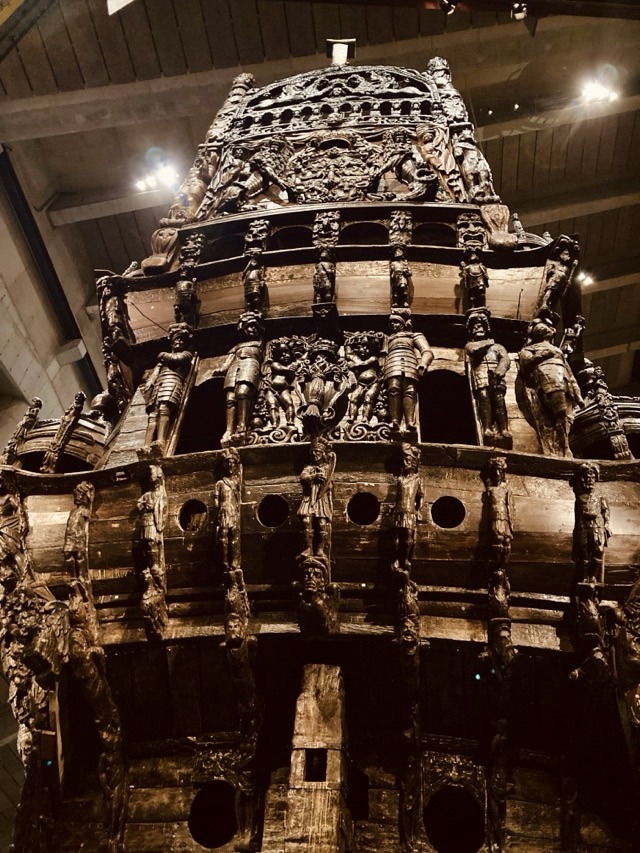
In 1990 the Vasa Museum opened up to display the ship; 98% of it has been preserved which is unprecedented.
While it was once a major knock against Swedish national pride, if it had ended up having a full career at sea, chances are high the Vasa would be nothing more than a footnote in history. Now, it’s one of the star attractions in the country.
Pictures don’t accurately convey the sheer size of this ship, and I thought the museum had a fabulous layout that helped us appreciate the true scale of everything.

The ship was held together with 8,558 iron bolts (very specific, I know!) and about 20,000 wooden nails.


There was a 20-minute informational video that gave a brief history of the Vasa and then we joined a 30-minute English guided tour (all these things are included with the price of an entry ticket and kids under 18 are free).
After that, we wandered around the museum for a few hours. You’re able to see the ship from all sorts of different heights and angles and the descriptive signs were incredible; this was definitely one of the best museum experiences I’ve ever had. If you happen to be visiting Stockholm, I cannot recommend a stop at the Vasa Museum highly enough.

Here’s a replica!

This is one of two “toilets” on the ship. Not exactly designed for privacy, the plaque joked that at least it was self-cleaning. The box opened up into the ocean below and the occasional high wave would wash it out. Gross but also FASCINATING.

One of the many gun ports; because these were left open to add to the pomp and circumstance of the grand sendoff, water was able to rush in as the ship keeled over.


You could see all sorts of artifacts recovered from the ship. I think a historically-minded person could easily spend a whole day in this museum.

There’s a relatively new section dedicated to victims who were recovered. One woman had notches in her teeth consistent with frequently biting through thread (so she was likely a seamstress of some kind). It was fascinating all the details about these people’s lives and status they could determine from where they were recovered and what was preserved.

You can’t touch main parts of the ship, but there is one piece of original wood accessible, so you’d better believe we touched it!

Over the centuries, while at the bottom of Stockholm’s harbour, the Vasa settled into mud and clay. At the same time, the city’s waste was being dumped directly into the water. Which sounds awful, but for an ill-fated ship, it was a stroke of luck. When waste rots, it produces hydrogen sulphide which consumes oxygen in the water. Ironically, this polluted water, low in oxygen, is the only reason the Vasa survived (wood-attacking fungi and bacteria can’t survive in this environment.)
I appreciated that the museum has lots of honest discussion about how the ship is slowly breaking down over time. It was treated with polyethylene glycol for several decades to allow it to retain water and prevent drying. There are 400 measurement points (you can see tiny little squares tacked up around the exterior of the ship) and measurement stations situated around the ship’s hull. It’s settling downward about 1 mm each year, and the stern is twisting slightly.
The ship is built to rest in water, where the entire hull would be evenly supported. In the museum, Vasa lies in a cradle that concentrates the load at a specific point which risks damaging the hull. It’s also not exactly light on its proverbial sea legs: the Vasa weighs about 800-900 tonnes (or the equivalent of six jumbo jets).

One of the biggest issues is tourists, like me. The carbon dioxide we breathe, along with the heat and moisture generated by our breath, bodies, and clothes, causes the wood of the ship to slowly break down. The lighting, temperature, and humidity within the building are all very tightly controlled by sophisticated systems, but even still, the Vasa has a limited shelf life, so to speak.
While we were there, they were replacing some of the bracing structures used to support the ship.
We also happened to be visiting at a time they had a special exhibition dedicated to James Cameron. He’s been a pioneer in the field of underwater exploration for decades and it was fascinating to learn how early in his life he had an engineer’s mind.
There were lots of original items from several of his movies, including Avatar (we saw Jake Sully’s animation capture mask).

And, of course, Titanic. It’s impossible not to see some overlap between the ill-fated maiden voyages of Vasa and Titanic.
We got to see Jack and Rose’s costumes from the movie. There were also original scripts, various set pieces, and all sorts of behind-the-scenes information about the filming of the movie.
I love, love, love behind-the-scenes information from movies, so it was perfect timing for us to visit the Vasa Museum!

Here’s the (fictional!) Heart of the Ocean diamond necklace prop piece from the movie.

There was an interesting little section about the use of diving bells; Indy was happy to demonstrate how they worked. I can’t help but feel this was a missed tree pose opportunity.


While I definitely could have stayed longer, by this point in the day John had a work call he needed to take back at our hotel, so while he navigated there, I took the kids around Djurgården, the island the museum is located on.
We didn’t have any set lunch plans; when the kids spotted a hotdog stand, I was game.
These were the funniest hot dogs I’ve ever had. Long and thin (the bun looks laughable), but they were also delicious. We sat by the water and ate our hotdogs. The older gentleman running the hotdog stand was charming and it was just a great little break in the day.

Belle is a big fan of ABBA and I had debated going to the world-renowned ABBA museum (on the same island), but it would have been yet another entry fee and I didn’t think Indy would be particularly keen on heading back inside to… read more plaques.
When he spotted a little mini-golf course we made the spontaneous decision to play a round and it was so fun. It was tucked in behind a gelato store and ended up being a really fun course. Every hole had something do with Stockholm’s history; it was quirky and a perfect way to spend an hour.


Next up was a water tour of the city. You can take paid tour cruises, but all the online intel I had come across said to save yourself money and buy a public transit ticket for the water taxis. You can literally ride these for HOURS and see all the major sites of the city from the water.
Sold!


Belle was ready for some quiet time, so she sat downstairs and Indy and I soaked up the sun’s rays from the open top deck.

Of particular interest to him was Gröna Lund, Stockholm’s amusement park. Both kids would have loved to go, but we had already done a lot of amusement park things on this trip, so they had to content themselves with watching from afar.


It was such a lovely way to see the city and all for the price of a public transit ticket.
We did an hour-long loop and it was great!


Here’s the Vasa Museum viewed from the water.

Coming to dock in the heart of the city…

By this point, John had finished his work meeting and had come back to meet up with us for a few final hours of exploration.
Since we only had two days in the city, it didn’t leave enough time to see everything that sparked my interest. Another time, I’d love to go to the Nationalmuseum (pictured below), and some of the other art galleries in Stockholm.

Since we were close, we walked over to get a picture with the famous gilded crown on Skeppsholmsbron Bridge.


We wandered around Gamla Stan for a while, and settled on a place for dinner: Fika & Wine.
I got a delicious fish dish, Indy got toast skagen, John got Swedish meatballs, and Belle sampled a bit of everyone else’s dishes!

Of course, we had to try semla for dessert. These are one of Sweden’s most famous pastries. They’re doughy cardamom buns filled with an almond paste and a giant dollop of whipped cream, topped with a “lid” and icing sugar.

Belle wanted to get Swedish fish IN Sweden, so we stopped by a grocery store to make that happen. (Buying a little bag in bulk was much cheaper than fancy candy store prices.)

I had bought a few postcards in Stockholm, so I mailed those before we headed back to our hotel.

And Indy said goodbye to his favourite Swedish statue.

And that’s a wrap on our whirlwind time in Stockholm. This is definitely a city I want to visit again one day.
Your turn.
- Have you ever been to Stockholm?
- When’s the last time you played mini-golf?
Discover more from The Optimistic Musings of a Pessimist
Subscribe to get the latest posts sent to your email.


You have sold me on Stockholm! I approve of the completism of you having Swedish meatballs and Belle having Swedish fish. I also approve of the 2:1 hot dog to bun ratio. That’s the way life should be!
Can you believe that you only had two days there??? You were able to do so many things in such a short time.
The Swedish meatballs were delicious and… I’m sure Belle enjoyed her Swedish fish. I gladly passed on those.
Those hotdogs were unusual and utterly perfect. Especially after being on our feet for hours. Plus, 1 million bonus points for the view.
We packed a lot into 1.5 days! Things are very concentrated; it’s one of the things I loved about the city.
The Vasa was one of the best museum experiences you’ve had- that is saying a lot! It sounds incredible, and I love the art in the subways as well. My friends- who I’ve convinced to go to Helsinki next summer- will have to add Stockholm to their trip. It looks like an incredible city. I also notice you’re wearing jackets (they don’t want to go somewhere hot so I think I’ve come up with the perfect itinerary for them). You definitely packed a lot into your two days there!
It is incredible. I wasn’t 100% sold before we went and the kids weren’t thrilled about going to a museum about… a ship?? But it was so well done and so impressive and I would definitely go back another time visiting Stockholm.
Feel free to give your friends my e-mail address or share some of my Helsinki/Stockholm tips. It’s a very easy cruise (and quite inexpensive!) to get from Helsinki to Stockholm.
I took a solo trip to Denmark and Sweden last August and I also was fortunate to visit the Vassa Museum. I loved it too. I spent hours there and only left because I was so hungry I needed to get something to eat. Next time you are there, you may want to check out the Royal Armoury. It was another absolute gem of a museum that I spent hours wandering around, learning so much about Swedish history! It was enjoyable to revisit Stockholm through your family’s experience.
Agreed that the Vasa Museum was an incredible spot!
There are so many more things I want to see in Stockholm so I definitely plan on going back some day.
I have been to Stockholm! I kind of regret not doing the ABBA museum actually. We enjoyed Stockholm but not quite as much as other places we visited that trip, so may have short changed it a bit. Your trip looks lovely! We did do Vasa and Skansen was also lovely!
I heard such great things about the ABBA museum; if we’d had more time, I definitely would have gone. Yet another excuse to make sure I go back sometime in the future.
Stockholm sounds amazing! I would love to see the Vasa museum and the ABBA museum. The funny hot dog looks quite good. I’ve never been to Sweden, but I’ve always had a fondness for all things Swedish.
Yes, the ABBA museum is on my must-see list the next time. I’d definitely go back to see the Vasa again, too.
I love the Vasa museum! I am moderately sad I didn’t get to take my kids to see it when we went in 2025, but I also knew we would be back. My kids LOVED swedish meatballs and I should put them on the menu again. I love pickles but am not as keen on lingonberry jam. You did so much with such a short amount of time.
I think your kids will get more out of the museum in a few years anyway. It is all very impressive and the museum layout is superb.
I’m with you; lingonberry jam is a bit bitter, but if I take the tiniest bite with the rest of it, it does seem to enhance the flavour.
Wow, that museum and story about Vasa is fascinating! Thanks for taking us along.
Stockholm definitely sounds like a place to visit. One of my friends from Germany moved there years ago (I think she has citizenship now) and really loves it in Sweden! The hotdog sausages look a lot like the German “Wiener Würstchen” (don’t ask me why they’re called Vienna sausages LOL) – have you had any while in Germany?
I didn’t have any hotdogs until we got to Sweden. These ones were worth the wait.
If you ever go to Stockholm, I think you’d love the Vasa Museum.
I’m glad you got to spend some time in Stockholm! it’s a beautiful city and even if I generally dislike big cities, I love Stockholm (and Göteborg too). I didn’t know about that wall art at T-Centralen! It looks beautiful! I rarely take the underground in Stockholm, it’s so chaotic so I do it only if I really have to, otherwise I walk because it’s such a walkable city. The boats around Djurgården are lovely!
I LOVED the subway art in T-Centralen; there are lots more stations and you can even take subway art tours!