


At the end of our 110 days in Europe, I put out a call for reader questions. Because there were so many—and a fair amount of repetition—I’m going to answer them thematically spread across a series of Q&As. (All the original questions are in the comment section of this post. A sincere thank you to everyone who took the time to leave a question!)
Today’s post is all about how we planned for 110 day (that is a lot of days!!) in Europe. (Sarah, are you proud of me?)
Table of Contents

How I Research and Plan a Trip
Several readers (most specifically Nina!) wanted to know how I planned our sightseeing days so efficiently. We seemed to visit several places in a single outing—as though we were following a carefully planned walking tour—and they wanted to know which books and/or websites I used.
The short answer: it involves a lot of research and a ridiculous number of Google Maps pins.
I suspect it will surprise no one to learn that I put a lot of effort into planning. I’ve written about this before (for example, how I planned a trip to Rome!) but the basic approach is consistent from one destination to the next.
The first step is going to Google; I use the exact same search terms whenever we travel:
- Best things to see in _______
- Hidden gems in _______
- Best free things to do in _______
- Most Instagrammable spots in _______
- Best one-day itinerary in _______
- Best three-day itinerary in _______
- Visiting _______ + blog
“Best things to see” gives me the obvious highlights.
“Hidden gems” helps me find more unusual places. I usually check the relevant Atlas Obscura list because our family tends to enjoy quirky attractions. (Atlas Obscura is how I learned about things like the Indecent Little Man in Brno, Strudlhofstiege in Vienna, and Linnahall in Tallinn… among many others.)
“Best free things to do in” should be self-explanatory. We like free things!
“Most Instagrammable spots” sounds a bit silly (especially since I don’t have any social media accounts!), but it tends to lead us to beautiful buildings/viewpoints/streets that don’t necessarily show up on traditional must-see lists.
A one-day itinerary gives me the greatest hits, so to speak. A three-day itinerary gives me a broader sense of the city even if we won’t actually be there for that length of time.
I also love reading blog summaries because they often include practical details that don’t show up on official tourism websites (where to find free bathrooms, attractions that have cash-only entry, etc.). The blog I used most frequently on this trip was Third Eye Traveller; she doesn’t know who I am, and we’re not affiliated/collaborating in any way.
Any results from the above search strings that catch my eye get pinned to a Google Map.

How I Use Google Maps to Build an Itinerary
Once all my pins are saved, I can see where everything is geographically, which makes it much easier to group nearby attractions together.
No one wants to traipse back and forth across a city all day… at least in my family! I aim to see things as efficiently as possible, especially if the kids are in tow.
Instead of starting with a rigid hour-by-hour schedule, I usually look for clusters. Are there three or four interesting places within a ten-minute walk of each other? Great! That’s an outing. Is there a museum that’s located away from the central hub? If so, I might try to pair it with a stop at a nearby park or cool landmark so the journey feels worthwhile.
If we’re taking a day trip, I tend to plan more carefully.
Our trips to Brno, Bratislava and Sopron all involved arriving by train mid-morning, so we wanted to see as much as we reasonably could on foot and get back to Vienna that evening. I didn’t want to waste half the day crossing and recrossing the same neighbourhoods! (Ditto for getting to Tallin via boat for a day trip from Helsinki.)
In addition to the digital versions, before we leave home I print off a paper copy of a screenshot of my Google map for each location, and often add a few handwritten labels. For a trip as big as our recent European adventure, I also had a spreadsheet for each destination with all sorts of details: opening hours, admission prices and little descriptions of what to look for in each place. I printed all of that on the back of the map.
Yes, it was a lot! No, you do not need to travel like this to have a wonderful adventure, it’s just how I choose to do things.
Reminder: Check Opening Hours, Weather and Terrain
Geography is only one piece of the puzzle.
I try to think through things like:
- Opening and closing times
- Timed-entry tickets, including whether admission is waived or reduced on certain days (this happens a lot in Europe!)
- Public transit schedules
- Weather forecasts
- How much walking everyone can reasonably handle
- Which attractions are the highest priority for us
- Where to stop for food or a bathroom

When we took a day trip to Bristol (which I still have not gotten around to recapping; oops), I knew the cathedral closed at 3 pm. I wanted to arrange our route so we naturally arrived at the cathedral while it was still open.
It was also going to be a hot day (the end of our time in Wales coincided with an epic heatwave in the United Kingdom) involving a fair amount of hilly walking. Each stop had to be weighed against its location, opening hours, and the amount of energy it would take from everyone.
We made it to the cathedral around 2:45 pm which was perfect.
So, the reason our sightseeing days sometimes looked like perfectly planned walking tours is that… they kind of were.
What Happened When Plans Went Awry?
Places were unexpectedly closed, transit was delayed (UK! Czechia! Austria!), the weather changed (I missed exploring the backlot at Warner Bros. because of a thunderstorm); sometimes we found something interesting and stayed longer than expected.
I like having a plan, but I try to remember the plan is there to make our day easier, not to hold us hostage.
If something went wrong, I could open my map and see what else was nearby. Instead of standing on a street corner wondering what to do next, we usually had a few backup possibilities in mind.
For me, maps provide structure while still leaving room to change course. (And sometimes the unexpected discoveries ended up being better than the original plan.)


Our Full 110-Day Europe Itinerary
Sara asked for a recap listing everywhere we spent our 110 days, which sent me on a very fun walk down memory lane!
Here’s the complete route, including our longer bases, shorter overnight stays, and day trips.
Munich, Germany: 5 Nights


We flew from Canada to Munich and spent just under five full days exploring the city.
Munich was a good place to start our trip: it was easy to navigate, had lots of interesting things to see, and wasn’t overwhelmingly large.
You can read my complete guide to the best things to do in Munich, including major attractions, hidden gems and our experience visiting Dachau with kids.
Vienna, Austria: 30 Nights


We travelled by train from Munich to Vienna and lived there for a full month. It was AWESOME!
Vienna was our first long-term base. We stayed outside the historic center (Nussdorf/Heiligenstadt) but could get anywhere in the city efficiently using a combination of trams, trains, and buses.
If you want lots more details, I have a variety of Vienna posts and travel guides, including a “highlights reel” summary of our time in the city.
While we were based in Austria, we also took three international day trips!
Being able to hop on a train and reach another country in a little over an hour was a novelty that never wore off. Back in Canada, we can drive for hours (sometimes for more than a day) and still be in the same province!
Our Alpine Road Trip: 7 Nights


After Vienna, we took the train back to Munich, rented a car, and completed a whirlwind 2,200+ km road-trip loop through all eight Alpine countries.
Our stops included:
- Vaduz, Liechtenstein – daytime stop
- Zurich, Switzerland — 2 nights
- Menton, France — daytime stop
- Monaco — 2 nights
- Venice, Italy — 2 nights
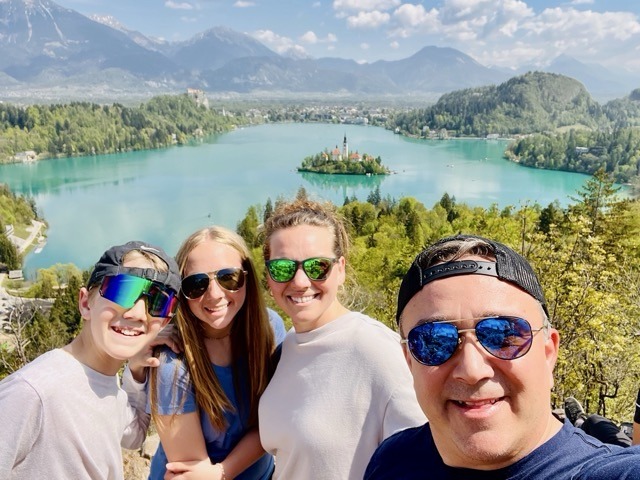
- Lake Bled, Slovenia — a last-minute daytime stop
(We also drove through Germany and Austria, the remaining Alpine countries.)
Some plans disappeared entirely (we were supposed to go to Ljubljana); other destinations were added at the last minute.
Helsinki, Finland: 30 Nights


After the road trip, we flew from Munich to Helsinki, with a connection in Riga, Latvia.
Helsinki was our second month-long base.
It took me a little while to warm up to the city, but by the end of the month I’d developed a genuine appreciation for its parks (which are everywhere), gorgeous libraries, and the slower pace of life. The kids loved the epic rollercoaster at Linnanmäki. While we were staying in Helsinki, we also took a ferry to Tallinn, Estonia for the day.
I have lots of Helsinki travel posts!
Stockholm, Sweden: 2 Nights


We travelled from Helsinki to Stockholm on an overnight ferry. It was transportation and accommodation rolled into one—how efficient.
We spent two nights in Stockholm before continuing by train to Denmark. You can find my Stockholm posts in the Scandinavia section of the blog.
Copenhagen, Denmark: 7 Nights


We stayed with my brother and sister-in-law in Copenhagen for a week.
In addition to exploring the city, we took day trips to Roskilde and the Danish island of Møn.
All my Denmark posts are in my Scandinavia travel archives.
London, England: 3 Nights


We spent a few days in London (connecting through Norway en route from Denmark) before travelling to Wales.
Our time included visiting classic London attractions and going outside the city for the Warner Bros. Studio Tour, which was one of the big-ticket experiences we had booked before leaving Canada.
Cardiff, Wales: Our Final Long-Term Base


We spent the remainder of our trip based in Cardiff.
We spent quite a bit of time exploring Cardiff and nearby spots like Caerphilly Castle and Penarth.
You can browse all my United Kingdom travel posts here.
Bristol, England: Day Trip From Cardiff
We travelled by train from Cardiff to Bristol for a full sightseeing day.
Edinburgh, Scotland: 3 Nights


Indy and I travelled from Cardiff to Edinburgh for a short but memorable Scottish adventure.
Even with only a few days, we saw enough to make me excited to go back and explore more of Scotland.
Paris, France: 3 Nights for John and Belle
Later in the trip, John and Belle spent three nights in Paris together. Their trip included a connection through Amsterdam on the journey back to Cardiff.
We visited Paris previously as a family, and you can browse all my Paris travel posts here.
Airport Connections
We passed through airports in:
- Riga, Latvia
- Oslo, Norway
- Amsterdam, Netherlands (John and Belle)
I know some people don’t count airport connections as visiting a destination, but technically our feet touched the ground in each of these countries!
The original version of the trip looked slightly different. At various stages we considered spending time in Albania and Portugal, neither of which ended up happening.
You can compare our final route with the very tentative plans I shared in my original family trip to Europe Q&A.
Best European Cities to Visit Without a Car


Sara also had a very specific—and practical!—question: which destinations would work especially well for a solo traveller who doesn’t have a car?
Vienna would be at the top of my list. The public transit system was excellent.
Helsinki and Copenhagen also had convenient public transit.
Most of the cities we visited were very walkable once we reached the center. Brno, Bratislava and Sopron were relatively straightforward day trips by train from Vienna, with the main attractions clustered closely enough to explore on foot.
Wales was the hardest place for us to navigate efficiently using public transit. That doesn’t mean solo travel without a car is impossible, but routes and connections frequently required more planning than they did in Vienna, Helsinki or Copenhagen.
Where Would I Recommend for a First Family Trip to Europe?
Emily is planning a first European trip with her tween and teen. Her family loves nature and adventure, and she asked which of the places we visited I’d recommend for a more conventional two-week family trip.
First, my instinct would be to avoid trying to visit too many countries in two weeks. Travel days take more energy than expected, and a constantly changing itinerary can make the trip feel like you’re always repacking suitcases.
From the places we visited, I would consider building a trip around:
Munich and Vienna
Munich and Vienna would be an easy pairing for a first trip.
Both cities have great public transit, major historic attractions, parks, museums, and plenty of things to interest parents and their kids. Travelling between them by train is also relatively straightforward.
Vienna offers the added bonus of easy international day trips to places like Bratislava, Brno and Sopron!
Scotland
Scotland would be a GREAT choice for a family interested in hiking, scenery, and outdoor exploration.
We only scratched the surface during our short time in Edinburgh, but I can’t wait to go back to explore the Highlands, the Isle of Skye, Stirling, and Glasgow.

Slovenia
We saw very little of Slovenia, but Lake Bled was beautiful and the country is extremely popular for hiking, lakes, and outdoor adventures.
Slovenia would be high on my list for a future nature-focused trip.
Barcelona, Paris or Portugal
From previous family trips, we also loved:
Each place offers a very different experience, so the best choice would depend on whether your family is most interested in major landmarks (Paris), food (Paris), beaches (Portugal), history and architecture (Barcelona), or outdoor activities (probably Portugal; there are some epic hikes!).
Would I Plan Another Long Trip the Same Way?
Yes.
The exact itinerary would change, but I would use the same basic system:
- Research broadly with my go-to search strings.
- Save anything interesting to Google Maps.
- Group attractions geographically.
- Check opening hours and transit.
- Prioritize the most important stops.
- Leave room for quasi-spontaneous adventures.
It required a lot of work before and during the trip, but it helped us make good use of our time without constantly wandering around wondering what to do next.
And I genuinely enjoy the planning process. (Well, most of it.)
Your turn:
- Does anyone have more questions about planning/itineraries?
- Do you plan sightseeing days carefully or decide as you go?
- What websites, blogs or tools do you use when planning a trip?
(Here are all the individual posts from our 110-day European adventure or you can visit my main travel page for more destination guides.)
Discover more from The Optimistic Musings of a Pessimist
Subscribe to get the latest posts sent to your email.


If I were going on a trip now, I would plan the itinerary more loosely than this. BUT, with kids, I think you have to be really meticulous. You can’t just wander around and be spontaneous. Question- if you were going alone, or just with John, would you plan it the same way?
I like your google questions, especially the one including blogs. I’m going to use that next time I travel!
A good point about being with kids! Yes, I DO think planning matters more.
That said, I plan in a similar way with John, but I feel like I hold the plans more flexibly.
Maybe some people will find my blog that way?
You must have been a travel agent in another lifetime! This detailed explanation shows how carefully you worked out your trip- and still gad room for flex!
I used to use AAA travel guides for the location we’d go to- it listed attractions, events, etc. Also I used our children museum reciprocal membership list to pick a place to go when we traveled with young kids. Nowadays I don’t travel for tourist/fun reasons, so I don’t use anything except Google for closest rest area.
Ha! I will admit that the thought of doing it for someone else fills me with dread.
Finding the nearest rest area is an important thing!!!
Fascinating post, Elisabeth! My husband is the travel
planner in our family and I am eternally grateful for that – it requires *so much* work! One thing he does is check out a variety of travel guides for the cities we plan to visit. It’s amazing how different they can be, in terms of recommendations. I really like how you print out your google map with all the pins on it – that is super smart.
Do you and your family have any must dos no matter where you go? Like, we always find the tallest attraction and we always check out the local ice cream places.
We tend to always aim to go somewhere high (the tallest point, a tower), we aim to always go to a grocery store, we aim to always take public transit (of some sort), the kids love to eat something at a McDonalds.
Sometimes I wish I didn’t do the planning, but I also think I’m too controlling to let go of it. John is a great planner, but I just like to be the one researching it. I also think I care more how the day goes (he’s happy with whatever), so it makes sense for me to do the planning since I’m a maximizer.
When you break it down that way, it all seems very manageable and doable in small chunks! (how to eat an elephant, you know…)
I find I use Reddit a lot for ideas on travel planning these days. I find there I can get a sense of what people have loved but also what people have felt wasn’t worth the time or money – and often you can tell by the post if it’s something that would appeal to me despite other people not liking it. But also when we went to Kuala Lumpur, we thought we’d just take public transportation everywhere, but the Reddit threads all said don’t do that and just take Grab (their version of UBER), and seeing such a consensus on one topic really informed how we got around. Also city specific Reddits often have good restaurant recommendations from locals.
I have tried to use ChatGPT for travel itineraries, and while it does give me logical and clear itineraries, it doesn’t really tell me why I would want to visit a certain attraction. Maybe I’m using it wrong?
I literally used that phrase “how to eat an elephant” so many times to calm myself down when the sheer scope of planning felt overwhelming!
I don’t tend to use Reddit much, BUT I did find my answer to the best place to find a gondola in Venice and it was perfect. Score one for Reddit.
I’m the Sara who asked 2 questions and thank you so much for answering them!! What an incredible experience to have planned and executed! Goals, for sure.
You are most welcome <3 Hope those answers helped/got the heart of your questions. Happy travelling!
All of the planning really paid off! What a great adventure.
I can be a little more casual about my trips when it’s just me. Usually I have a reason why I’m going to a place (FLW house, state capitol), and from there I use Trip Advisor and Google to come up with other things in the area. I’m still trying to find the balance between doing All The Things and taking some time to relax. For example, I’ve been on the go all week and I was starting to get tired, and I’m staying in a really nice Airbnb. I had a list of four places to go today, and two of them were musts and two were “that sounds interesting”. I ended up doing the two musts and then I spend the afternoon lounging in the Airbnb and have no regrets.
I so rarely use Trip Advisor, but I think it’s Kae that uses it a lot? It never crosses my mind… but it should!
YES. Lounging is so important. We had complete days of “nothingness” and it was great. I think it’s fun to lounge somewhere new, too. It feels different than taking it easy at home.
I always have fairly detailed plans for our holidays because otherwise G gets tetchy when I’m vague about what we’re going to be doing. Some of the things I wanted to do in Wales, the information was a little bit vague, and when I said we need to go and work it out once we were there, there was a little bit of grumbling about it but we didn’t end up having any problems. I am careful to make sure I don’t overprogram the days, though. Sometimes I will have an outline of various day schedules, and then I slot them in according to the weather and what we feel like doing that day, if it is something that doesn’t need reservations. Usually, for reservations, I like to book before we arrive, and I usually check if things are likely to get booked out.
I like to start planning by browsing a guidebook, which is pretty old school. Then I go to Google. I actually prefer information from blogs to generic travel sites. Tripadvisor used to be so good but has gradually got worse and worse. For our trip coming up, I’ve actually used ChatGPT a little bit (I have a paid version for work), but you have to keep pushing it, and then I check the sources myself. I want to do a hike in the Rhine, and I went back and forth with it a few times before I made a decision. I just kept getting it to come up with a few different options each time until I settled on what suited me. One really good use of AI is to get it to trawl through reviews. So, for instance, we like our accommodation to be quiet, so I get it to scan the reviews of places I’m thinking of staying at to see whether people complained that it was noisy. It also recommends quieter areas to look at.
Ha! I am “G” and you are John, except I do most of the planning because if not I would be VERY touchy!
I’ve never used Tripadvisor, but I know it’s the first stop for a lot of travelers. Like you, we want our places to be quiet at night; I’ve never run reviews through AI, but that’s a good use of the technology!
First of all, oh my goodness, huge props to you for this post- I feel like this one had to have been very time consuming to write and link! Well done.
Second, I love how you did the “overview” of your itinerary! When you were actually traveling sometimes it was a little hard for me to keep straight where you were/how long just since obviously it was not possible to keep up posting in real time. This puts it all together so nicely! I almost feel like the itinerary overview should have been a separate post so it would stand out more! I suppose it’s not that likely many people would be doing an exact itinerary like that just due to the length of time you were away, but still! So great and I loved seeing it like that.
It’s just so amazing and impressive what you guys put together and it warms my heart so much that it all worked out, too! Sometimes plans don’t always go quite as, well, planned, but I’m so happy that for you guys, it really did!
These summary posts take SO MUCH TIME… but they’re also my favourite to have and I feel like the most useful if anyone wants to get ideas.
Thinking through the itinerary was my favourite part of writing that post. Also… a bit exhausted. Phew. That was a whirlwind!!