


We spent a full month living in Vienna as a family, and that gave us time to visit a lot of famous landmarks, check out different museums, use the public transit system (repeatedly!!), eat lots of food, take day trips to three different countries (Slovakia, Hungary, and Czechia), and discover some quirky hidden gems (my favourite!). If you’re planning a trip and want to figure out the best things to do in Vienna without digging through a month of my diary-style posts, this is your one-stop guide.
Vienna is packed with palaces, gorgeous churches, and world-famous art. But it also has a free museum about the history of the city, an aquarium inside a former anti-aircraft tower, a beautiful waste incinerator (really, it’s gorgeous), a micronation, and a visually stunning justice building. In other words, there is a LOT more to Vienna than the Habsburgs and classical music. (Though I will talk about both the Habsburgs and classical music in this post.)
Vienna is consistently ranked among the most liveable cities in the world (it was first for three consecutive years, before placing second to Copenhagen in 2025/2026), and after a month of calling this city home, it was easy to understand why. When people ask where we could envision living in Europe, Vienna is at the top of my list.
I’ve already written long recaps of our adventures, complete with hundreds of pictures. Just like I did for Munich, I wanted to pull everything together into one condensed planning guide. If you like lots of words and plenty of photos, here’s the whole shebang:
- Vienna Travel Diary: Our First Weekend in Austria with Kids
- Vienna Travel Diary: Family Adventures & Hidden Gems During Our First Week
- Vienna Travel Diary: Our Second Week of Family Adventures (+ Some More Hidden Gems)
- Vienna Travel Diary: Our Third Weekend in Austria
- Walks Around Vienna (AKA: A Giant Photo Dump)
Okay, let’s jump in!
Table of Contents
Best Things to Do in Vienna at a Glance
Our top picks: Prater amusement park was a favourite family splurge. Schönbrunn Palace and Zoo felt like an authentic Vienna experience. We also loved the Light of Creation show at Votive Church and thought Haus des Meeres (Vienna’s aquarium) was one of the best indoor attractions we visited on our entire months-long trip.
Best free attractions: I highly recommend touring the Austrian Parliament, visiting the nearby Palace of Justice, exploring St. Francis of Assisi Church, and checking out the permanent collection at the Wien Museum.
Favourite hidden gems: Some of our favourite unexpected discoveries included Ferstel Passage, the mosaic reproduction of The Last Supper, and the colourful Spittelau incinerator.
Favourite views: Cobenzl viewpoint (Cobenzl Aussicht) and Jubiläumswarte.
Best day trip: Brno (Czechia) was my favourite because it offered a fun variety of things to see. (While we didn’t go, Salzburg is the “classic” Vienna day trip.)
Must-See Palaces and Historic Landmarks in Vienna


Schönbrunn Palace and Gardens
This is the former summer residence of the Habsburgs (you will learn very quickly that pretty much everything in Vienna eventually points back to the Habsburgs) and a UNESCO World Heritage Site. The main park is free to explore, and the grounds are sprawling: there are formal gardens, fountains, monuments, a maze, and the famous Gloriette viewpoint (we promise it’s worth the climb).
Palace tours and some garden attractions require tickets; check the official Schönbrunn website for hours and prices. We didn’t pay to enter anything, so I can’t offer any feedback on the interiors, but I hear they’re fabulous.
We were also lucky enough to be in town for the Schönbrunn Palace Easter Market—more on that below.
Hofburg Palace and Michaelerplatz

The Hofburg complex is also enormous: museums, imperial apartments, courtyards, and the Spanish Riding School. We mostly explored the exterior, which is free and worth checking out if you’re spending time in the city.

Michaelerplatz, directly outside the palace, has excavated Roman ruins from the 1st-century settlement of Vindobona. It never ceases to amaze me that ruins this old are just… sitting in the middle of a modern European capital.
St. Stephen’s Cathedral (Stephansdom)


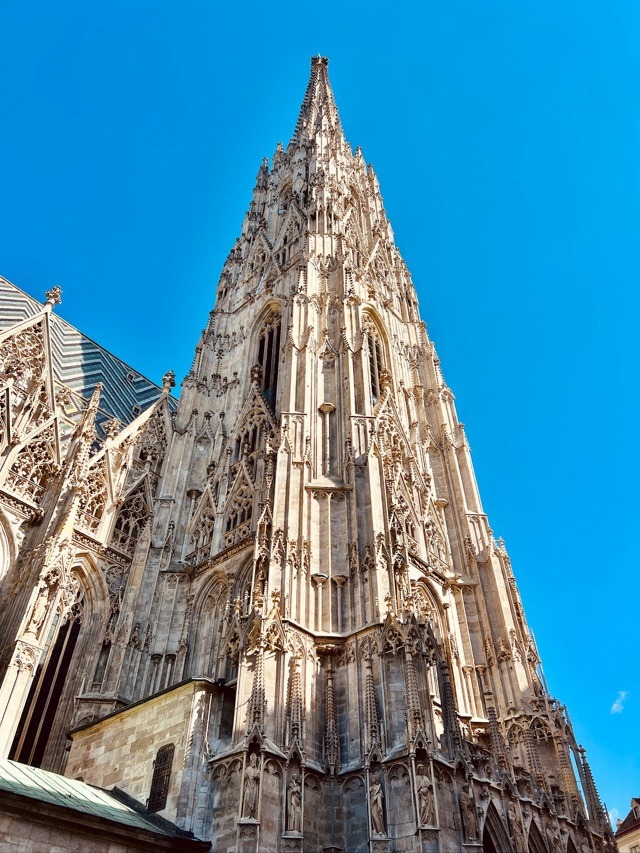
This cathedral is Vienna’s most iconic landmark and a natural starting point for exploring the historic center. The tiled roof is gorgeous. You can enter the main part of the cathedral for free, but you’ll need tickets to tour some other areas and for tower access.
I’ll admit I found the interior creepy—it was dim and hazy when we visited, probably from all the candles, but there’s no denying it’s impressive. We stayed at ground level instead of climbing the tower, saving money and our leg muscles.

Tip: Right around the corner is Mozart’s apartment (Domgasse 5). We didn’t pay to go inside, but the spinning portrait wheels out front were a surprise hit with our tween son.
Belvedere Palace


This is actually a series of buildings, and the grounds are beautiful. The gardens are free to explore, but entering the palace requires a ticket. The palace is now an art museum, most famous for housing Gustav Klimt’s The Kiss.
Tip: there are bathrooms on site, but they’re pay-per-use and coin only, so come prepared!
Beautiful Churches in Vienna
Karlskirche (St. Charles Church)

This is one of Vienna’s most distinctive churches. It has an enormous dome, two decorated columns, and a photogenic reflecting pool out front. You have to pay to go inside (a classical concert ticket includes entry; unfortunately, the timing just never worked out for us to attend), so we admired it from outside. It’s right beside Karlsplatz and the Wien Museum, making the stops easy to combine.
Votive Church (Votivkirche)


The Votive Church reminds me of a mash-up between Notre Dame and Sagrada Familia, and it’s spectacular lit up at night. It hosts a famous Light of Creation light and music show that’s incredible.
St. Francis of Assisi Church


This church is a bit of a trek from the city center, but the exterior looks like something from a Disney movie or a Harry Potter set (when we visited at night, we all agreed it screamed Hogwarts). The inside is very simple, but also worth a visit (free entry).
Minoritenkirche

This was one of the more unusual churches we visited; inside is a full-size mosaic reproduction of Leonardo da Vinci’s The Last Supper, commissioned by Napoleon and weighing more than 20 tons.
Peterskirche


We wandered into Peterskirche during choir practice, which was lovely. There are often horse-drawn carriages waiting directly outside this church.
Jesuit Church


The Jesuit Church dates back to the 1600s and is stunning architecturally (I still have questions about the modern art at the front).
Best Things to Do in Vienna with Kids


Schönbrunn Zoo
Located on the palace grounds, Schönbrunn Zoo dates back to 1752 and is considered the world’s oldest continuously operating zoo! It’s also home to giant pandas—which was a VERY big deal for our son who has been obsessed with pandas for years.
Tickets were €29 for adults and €17 for kids during our visit (here are current prices on the official zoo site), so it’s not a cheap outing, but it came highly recommended by my crew. Read more about visiting Schönbrunn Zoo and Palace with kids.


Prater Amusement Park
Prater was the most exhilarating—and one of the most expensive—family outings of our month in Vienna. There’s no general admission fee: you wander in for free and pay per ride, which is great if you want to try one or two things… but adds up quickly. (We managed €131.50 in a single afternoon. Womp, womp.)
Prater is also home to Kugelmugel; see more on that in the hidden gems section. Here are all the prices, favourite rides + tips for visiting Prater with kids.


Wiener Riesenrad
Vienna’s historic giant Ferris wheel was built in 1897 and featured heavily in the Orson Welles movie The Third Man. It’s located close to the main entrance to Prater. We rode after dark, which was magical—the amusement park looked incredible from above, and the slow ride gave us plenty of time for pictures. Again, since Prater has free entry, you could visit just for a ride on the Ferris wheel and call it a day.


Haus des Meeres (the Vienna Aquarium)
This is an aquarium and indoor zoo (there are a few tropical sections where animals roam freely, which was SO FUN) inside a former WWII anti-aircraft tower! There are multiple floors of sharks, tropical fish, reptiles, birds, and monkeys, plus a hands-on pool where little fish nibble at your fingers.
Big bonus: the rooftop terrace, included with admission, has excellent views over Vienna. It’s open late and makes a great rainy-day option—hours and prices on the official Haus des Meeres site. We went on Friday evening, when there’s a reduced admission rate (each weeknight after 5:30 pm). Read more about visiting Haus des Meeres with kids.


Setagayapark
This is a small, but very beautiful, Japanese garden in a quieter part of Vienna, with quaint ponds and bridges. It’s especially popular in cherry blossom season, and the resident turtle population was a huge hit with our son. It’s a lovely stop if you’re nearby and need a break from palaces and museums.
Best Free Things to Do in Vienna


Vienna City Hall
City Hall is a dramatic neo-Gothic building, and the front square is where lots of Eurovision 2026 events were held this year. It’s always a busy spot and you can get free tours of the interior, but they were all booked up when we were in the city.


The Austrian Parliament
The Austrian Parliament is one of the most visually striking buildings in the whole city. Entry is free, as are the guided tours. When we visited, there were two options: a ~55-minute “political” tour and a ~30-minute “photo tour.” We chose the photo tour because the kids weren’t exactly clamouring for an hour-long lecture on the Austrian political system! Tours do “sell out,” so book a few weeks ahead on the official Parliament site, and make sure to bring photo ID for the airport-style security. The restored interior is beautiful, and there’s a top-floor cafe and terrace. Here’s my full guide to taking a free tour of the Austrian Parliament.


Visit the Palace of Justice
Who knew justice buildings would turn out to be some of our favourite European hidden gems? (We visited one in Munich too—apparently this is becoming our thing.) Vienna’s Palace of Justice is home to Austria’s Supreme Court, but the public can enter during designated hours after passing through security. There is an entry cap each hour, so time your visit with that in mind!
The central hall is spectacular: a GORGEOUS staircase, giant columns, and a glass ceiling. It all reminded me a bit of the grand staircase from the Titanic. There’s also a rooftop cafe with great views over the city. It’s free, quick to visit, and right beside the Parliament building. Here’s lots more about our experience visiting Vienna’s Palace of Justice.


Explore the Wien Museum (Karlsplatz)
This was one of the best-value attractions we visited because admission to the permanent exhibition is FREE, and the museum traces Vienna’s history through interesting displays, cool models, and hands-on stations. The kids loved the light-table “build your own city”; there was also knight armour to try on, which was shockingly heavy (how did they move???). And don’t miss the papier-mâché model of St. Stephen’s Cathedral that took over 10 years to make.
HUGE bonus: this museum has excellent free bathrooms on site, information all family travel guides should provide. You can find details on the official Wien Museum site and here’s a longer blog post about our visit.

Take a Free Walking Tour
Free (tip-based) walking tours are a fantastic introduction to the city; we opted for Red and White Tours and learned all sorts of Habsburg history. (This is the exact tour we took; it’s not an affiliate link of any sort. When we chose this option, they had a 5.0 rating with over 1,000 reviews on Google!)


Walk Through Ferstel Passage
This is a beautiful covered shopping “arcade” from the 1860s, full of boutiques and cafe. We happened to arrive while an a cappella group was performing in the atrium; the acoustics were incredible, and I got goosebumps listening to them sing.
Best Museums in Vienna
I already covered the fantastic (and free!) Wien Museum!


Kunsthistorisches Museum
I think it’s worth visiting for the building alone—marble staircases, painted ceilings, and enough decorative detail to compete with the artwork (Bruegel, Raphael, Vermeer, Rubens…). John and I visited without the kids. People have given me plenty of excellent suggestions for making art museums engaging for children through games and scavenger hunts, but you know what’s even easier? Leaving the kids at the apartment!
Read more about our visit to the Kunsthistorisches Museum; current hours are on the official museum site. Highly recommend if you enjoy art and beautiful buildings.


Beethoven Museum + Virgilkapelle
The Beethoven Museum is set in a house where Beethoven lived and worked, covering his life, career, and famously particular habits (apparently he counted out exactly 60 coffee beans each morning).


Virgilkapelle is a roughly 800-year-old medieval chapel hidden beneath the Stephansplatz subway station, rediscovered during construction of the underground. It’s not a huge attraction, but stepping off a modern subway platform into a medieval chapel is pretty cool.
We did both on Vienna’s free first Sunday of the month entry to a number of museums—here’s my post about the Beethoven Museum and Virgilkapelle. That same day, we visited Beethoven’s grave in Vienna’s Central Cemetery.


Vienna Crime Museum (Best for Older Kids)
The Crime Museum covers the history of crime, policing, and forensic investigation in Vienna. My criminology-curious teen was fascinated, and it made an ideal one-on-one outing… but the displays were more graphic than I expected, and I was very glad I hadn’t brought my younger child. Most descriptions are in German (we rented an English-language guide and I feel having the audio guide is a must). Read more about our day at the Vienna Crime Museum.


Museum of Natural History Vienna
The Natural History Museum is enormous, and the building is almost as impressive as the exhibits. Highlights include giant dinosaur skeletons, a meteorite collection, and a really cool section about gems and precious stones. That said, my kids just… aren’t that enamoured by natural history museums. I agree they can be a bit boring, so I’d recommend this museum with the caveat that certain kids might find it tedious. If you happen to like natural history, this is an excellent stop.
Vienna Hidden Gems and Quirky Places

Hundertwasser House + Kunst Haus Wien
Friedensreich Hundertwasser was a famous (and eclectic!) Austrian artist, and his buildings are unlike anything else in Vienna. Hundertwasser House looks like a patchwork quilt, with trees and shrubs growing out of the windows—like something out of a Dr. Seuss book. It’s free to admire from the street, and Kunst Haus Wien (his museum) is nearby.

The Spittelau Incinerator
A waste-incineration plant is not normally something I’d put on a travel itinerary, but Hundertwasser redesigned this one with bright colours, quirky tiles, and a chimney wrapped in what looks like an enormous golden disco ball. We stumbled across it on a long walking day and immediately declared it the coolest incinerator we had ever seen.

Strudlhofstiege
This staircase reminds me a lot of the Spanish Steps in Rome. One of my favourite things about older European cities is how the architecture is seamlessly woven into everyday life; we watched school kids schlepping backpacks and scooters up these stairs on their way home. You know what I’m going to say next, right? It would make a stunning spot for wedding photos!


Shakespeare and Company
This is an ADORABLE bookstore on a little side street. It was so cozy inside, packed to the rafters with books for sale, and a must-visit for any bibliophile.

Kugelmugel
Inside the Prater grounds there’s an odd-looking house-turned-“micronation.” In 1971 an artist built a round house that was deemed illegal, so he declared it its own country… complete with a postal system and currency! (That’s dedication.) After he served some jail time and attracted lots of publicity, the Austrian government suggested he move it to the amusement park, where it stands today. It was closed when we were in town, but there are sometimes temporary art exhibits inside.
Parks, Views and Beautiful Places to Walk


Jubiläumswarte
This tall tower (free!) offers great views of Vienna. It’s a bit of a trek to get to it, but the kids really enjoyed this adventure into the Vienna Woods.

Stadtpark
Absolutely GORGEOUS, home to the Johann Strauss monument (one of Vienna’s most photographed landmarks), and a flower clock that actually works.


Kurpark
This is also a bit of a trek to get to, but was a highlight of the month for our son. There are ziplines and all sorts of quirky art installations. We stayed for hours and could have spent longer.

Burggarten
A lovely green space, complete with the Mozart and Franz Joseph monuments.


Cobenzl and the Vienna Woods
This steep climb passes vineyards and Sisi’s Chapel and offers panoramic city views. You can take a bus to the top, and there are restaurants on site.


Leopoldsberg is another viewpoint nearby; the church was under construction when we visited, but the walk down still has excellent views.


Walks Along the Danube
There are great pedestrian routes and plenty of street art. We also encountered an enormous group of swans (they’re beautiful but notoriously aggressive when approached by humans).
For a whole lot more of the city’s prettiest corners, here’s my giant photo dump of walks around Vienna.
Seasonal Bonus: Vienna’s Easter Markets


Vienna takes Easter decorating VERY seriously. We came across several Easter markets, but the Schönbrunn Palace Easter Market blew the others out of the water. Food stalls! Crafts! Enormous decorations! And a free hay-bale maze that functioned primarily as a climbing structure.

Another market in the historic center displayed thousands of painted eggs, with signs clearly stating that if you broke an egg, you bought it. The eggs survived our visit… and my blood pressure eventually returned to normal.
What to Eat in Vienna

Coffee at a Viennese Coffeehouse
Viennese coffeehouse culture is recognized on Austria’s UNESCO national inventory of “intangible cultural heritage.” Coffee arrives strong, on a tray, with a glass of water, and cafes are designed for lingering.


Wiener Schnitzel at Schnitzelwirt
This is a famous spot for authentic schnitzel and Käsekrainer (cheese-filled sausage wrapped in bacon), served with fries and sauerkraut. No vegetables were harmed in the making of that supper. The portions are huge, the prices are reasonable, it’s packed with locals, and it’s cash only!
Sachertorte
Vienna’s famous chocolate cake with a thin layer of apricot jam. We tried a slice from a smaller cafe rather than the famous (and expensive) Hotel Sacher. Our verdict: fine. I’m glad we tried it, but Paris has ruined me for fancy desserts.
Bakeries, Markets + One Very Good Pastel de Nata


Bakeries and markets are often easier and cheaper than a restaurant for every meal, and everyone gets to pick something different. Special mention to Nata, a Portuguese bakery with delicious pasteis de nata; we make a point of hunting down pasteis in every city we visit.
Tip: If you visit Schönbrunn Zoo, check your entry package… ours came with a 25% Lindt coupon, which we happily put toward a very fancy hot chocolate.


Practical Tips for Visiting Vienna with Kids
- Free bathrooms: the Wien Museum is your friend. Elsewhere, expect pay-per-use (often coin only, like the ones at Belvedere), so keep change handy.
- Public transit was one of the easiest systems we used in Europe: underground, trams, and buses reach nearly everything. We stayed outside the tourist center and got around entirely by transit and walking; by the end of the month we were navigating the city with a high level of confidence.
- Group attractions geographically. St. Stephen’s, Hofburg, Ferstel Passage, Peterskirche, and Virgilkapelle cluster together; Parliament, the Palace of Justice, City Hall, and the Votive Church form another easy group. Schönbrunn, Prater, and Cobenzl each need more travel time.
- Book ahead + carry some cash. Reserve the Parliament tour a few weeks out, and note that some restaurants (like Schnitzelwirt) are cash only.
- Mind the season: the city’s fountains are shut off during the winter (photos above: Hochstrahlbrunnen Fountain opened for the season while we were in Vienna!), and some spots (like the MQ Libelle rooftop terrace) don’t open until later in the spring.
Best Day Trips from Vienna
Vienna is an excellent base for international day trips. During our month in Austria, we visited Slovakia, Hungary, and Czechia without ever changing accommodations.


Bratislava, Slovakia
One of the most popular day trips from Vienna, reachable by train, bus, or even boat. We explored the Old Town, saw the Blue Church, visited Bratislava Castle, and hunted for the city’s quirky statues. Here’s my complete guide to taking a Bratislava day trip from Vienna.


Sopron, Hungary
A compact historic center with colourful buildings, ancient walls, and the iconic Fire Tower. Sopron (pronounced like Show-prawn) was quieter than Bratislava and easy to explore at a relaxed family pace. Here’s our itinerary for a day trip to Sopron, Hungary.


Brno, Czechia
Brno was full of unusual attractions: a dragon, an astronomical clock that looks nothing like a clock, and a Cold War nuclear bunker. In other words… something for everyone!? Read about everything we fit into our day trip to Brno, Czechia.
Popular Vienna Attractions We Didn’t Visit (for Next Time)
- Touring the inside of Hofburg Palace (including the Sisi Museum)
- Going inside Belvedere to see The Kiss
- The Spanish Riding School
- A performance (or tour) at the Vienna State Opera
- Climbing St. Stephen’s tower
- MQ Libelle rooftop terrace (closed for the season while we were there)
- Leopoldsberg Church (under construction when we visited)
- Taking a horse-drawn carriage ride
- Going to see Vivaldi’s Four Seasons at Karlskirche
Frequently Asked Questions About Visiting Vienna


Is Vienna good for families?
SO GOOD. It’s easy to navigate, transit is excellent, and you can alternate palaces and museums with parks, amusement rides, aquariums, and random street discoveries.
How many days do you need in Vienna?
We had four weeks and didn’t run out of things to do. Most families could cover the major highlights in three or four full days. That’s enough time to explore central Vienna, Schönbrunn, Prater, and a museum or two. A week allows a much more relaxed pace, several hidden gems, and a day trip.
A month gave us time to experience Vienna as a temporary home rather than just a sightseeing destination. But if you’re trying to decide how much time you need for the best things to do in Vienna, here’s my free advice: take whatever number of days you were planning… and add a few. We had a month, and I still left with a list!
What are the best free things to do in Vienna?
The Wien Museum, a guided tour of the Austrian Parliament, the Palace of Justice, the Schönbrunn gardens, and a tip-based walking tour. Vienna has more quality free attractions than most cities we’ve visited.
Is Vienna expensive with kids?
It can be. The zoo, aquarium, and Prater add up quickly (see: €131.50 in one afternoon). But the free attractions balance things out, and shopping at grocery stores and bakeries kept our food costs reasonable.
That said, a lot of museums with paid adult admission are free for kids under 15 or 18, depending on the museum, and public transit rates are heavily reduced for kids.
What’s the easiest day trip from Vienna?
Probably Bratislava. The Slovak capital is the closest and simplest—reachable by train, bus, or even boat—and you can easily see the highlights in a day. That said, Brno was my favourite of our three day trips (a lot of different things to see and do), so if I had to pick one, I’d head to Czechia first!
Can you visit Vienna without a car?

Yes! We spent a whole month using only public transit (and walking, of course). The system of trams, buses, and subways was spectacular and, compared to lots of other cities we visited, the transit passes were relatively inexpensive.
Your turn.
Feel free to add any of your highlights from Vienna in the comment section for anyone who might use this post as a planning resource!
Discover more from The Optimistic Musings of a Pessimist
Subscribe to get the latest posts sent to your email.


We are going to Vienna next spring, I will reread this closer to the date!
Squeal. I am so excited for you and jealous. We really loved the city and I do not think you’ll be disappointed, my friend!
It must have taken an entire day to compose this post.
Just skimming through the photos, I felt nostalgic, a little sad, perhaps even a bit homesick for your traveling life with all its new discoveries, excitement, adventures, and freedom from Everyday Same Olds, a big let-down of It-Is-Over-After-Months-of-Planning. Do you feel that? Because if I feel it vicariously, it seems as if it would flatten you at times.
It took a long time. But I have people who ask me for advice for places we’ve gone and I’ve been in the habit of just sending ALL the links to the “diary-style” posts and it’s just… not very effective. I hope to slowly but surely do these sorts of roundup posts for most of the places we’ve been.
It’s so sweet of you to ask about the emotional letdown. It’s not bad (it was roughest the first week or two back), but it’s definitely very real. Belle told me just the other day how much she misses Europe. A little piece of our heart was definitely left behind and we’re all itching to travel again. Well, maybe not Indy. He loved the trip, but is equally happy to be home and with his friends again <3