
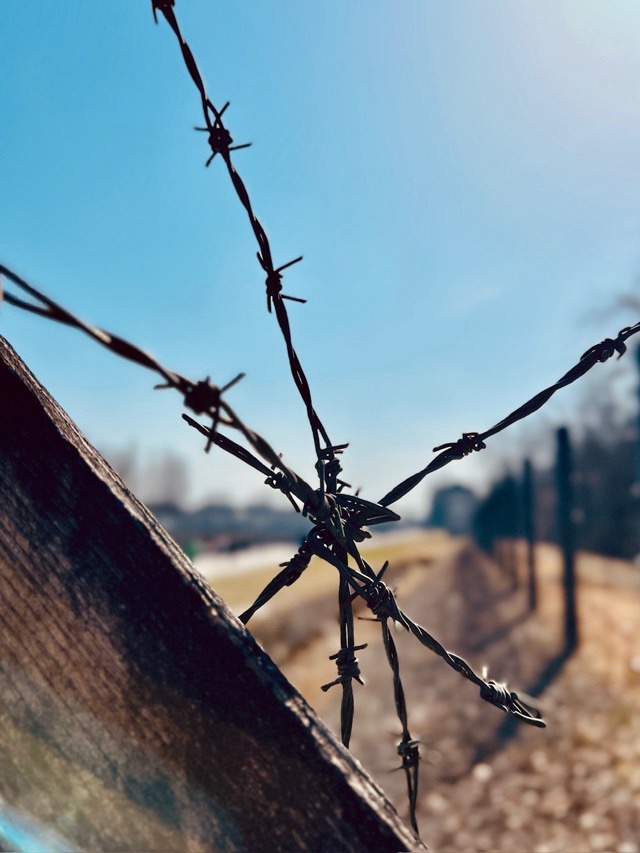


Content warning: I’m going to discuss our visit to the memorial site of the Dachau concentration camp. I won’t be sharing images of the violence that occurred there (and we didn’t take any), but the subject itself is heavy and sensitive. I will be including some pictures of the grounds.
I wanted to write about our experience in a separate blog post so readers can clearly identify the subject matter and skip it as needed.

When I was planning our trip to Munich, I found it surprisingly difficult to find clear information about visiting the Dachau Concentration Camp Memorial with tweens.
Should you visit Dachau with kids?
For months leading up to our trip, I debated whether we should go. Children under 13—Indy’s age category—aren’t allowed to join official guided tours because of the nature of the history being covered. I spoke with a few people who had already visited the site (including my brother and father) and heard a range of opinions about whether bringing a child was appropriate.
In the end, we decided to go.

My main takeaway is that parents should proceed with care and consider the temperament and sensitivity of their children. There were disturbing pictures, but most were not overly graphic (but of course there were some). There are horrific details about death by starvation and overwork, heinous medical experiments, beatings, and other torture mostly described in placards in the museum exhibits. Indy skipped reading these without any prompting… because he’s eleven and not interested in anything with that many words!
While they had a room displaying some personal belongings from prisoners, there was no room full of shoes or clothing, so the emotional gravity is lower than what I’ve been told to expect at the Auschwitz memorial.
I did not find the site sensational in any way; the tone is reflective and educational.

I suspect I would have absorbed a lot more information if we’d taken a guided tour (€4 per adult when booked on-site; reservations are not available, though there are lots of independent tour options). Because of Indy’s age, our only option was to rent audio guides (€5 each) and explore independently. I noticed several other families with younger children doing the same. There appeared to be dozens of school groups there with teenagers, so it’s definitely something that German kids are exposed to at a relatively young age.
We rented two audio guides; I found them somewhat underwhelming. That may have been because Indy and I were sharing one and he wasn’t especially engaged with the narration!

We spent several hours walking around the grounds and going through the museum. The site itself is not overly large. The original prisoner barracks were dismantled decades ago, but one has been reconstructed to give visitors a sense of what they were like when the camp was operational.

We also watched a documentary shown at the memorial (about 40 minutes long), and I would highly recommend it—especially for anyone who’s not able to join a guided tour. There were some graphic images included in the film, but nothing felt like it was too much for our children. Again, sensitivity to this sort of material would be highly individual for both kids and adults.
History of Dachau Concentration Camp


Above the entrance gate are the words “Arbeit macht frei,” which translates to “Work makes you free.” The phrase is one of the most chilling symbols of the deception used by the Nazi regime.
Dachau Concentration Camp was established in 1933 and was initially intended for political prisoners (in other words, anyone who opposed the regime). It quickly expanded to imprison people the Nazis sought to dehumanize and exterminate: Jews, clergy, Roma and Sinti people, immigrants, and sexual minorities.
A speech by Nazi official Johann‑Erasmus Freiherr von Malsen‑Ponickau captured the ideology behind the system: “We do not consider them human beings as we are, but as second-class people.”
And they were treated as such.
Survivor Adam Kozłowiecki reflected on the conditions inside the camp this way: “Sallow skeletons with large, sad eyes… Some of the looks expressed pleading for help, others complete apathy. It is incomprehensible that something like this can happen in the twentieth century in the heart of Europe.”
Approximately 41,500 people were murdered at Dachau. That specific terminology (murder) is very prominent on site.
The camp also played a crucial role in the expansion of the overall Nazi concentration camp system. It became a model for other camps that followed, and personnel who later ran other camps—including Auschwitz—received training there.
The camp was liberated on April 29, 1945, by troops from the United States Army. It was the longest-running concentration camp in World War II.
Why Visiting Dachau Matters
Actually standing inside the grounds of Dachau (walking through the very gate prisoners would have come through) is very different from reading about it in a history book.

Places like this exist to honour the lives of those murdered while reminding us that the atrocities of the twentieth century were not ancient history—they happened within living memory, carried out by ordinary people within systems that normalized cruelty and dehumanization.
For our kids, the goal was not to expose them to the horrors of evil, but to help them understand the importance of human value and dignity, and the consequences when societies allow hatred and discrimination to take root.
Indy definitely didn’t fully grasp the gravity of the place. That’s okay and likely a good thing! What mattered was that he experienced it respectfully and began to understand that history is real, and that remembering it matters. As he moves into higher grades at school, he’ll study the Holocaust in greater depth and I suspect our visit will take on fresh meaning at that point.

Memorial sites like this exist so that the world doesn’t forget. They ask visitors not only to look back, but also to reflect on the responsibility we all share to recognize injustice and prevent it from happening again.

It was… heavy. The certainty with which the world declared Never again is sad. After John’s recent trip to Rwanda, we were all thinking about the genocide in that country. One million people in 100 days? Unthinkable, right? After the lessons learned from the evil that was exposed less than fifty years before?
History repeats itself again and again, which is heartbreaking. Hopefully the truth preserved at these memorial sites helps inform future generations and prevent similar evil.

It was also incredible to learn about the resiliency of prisoners. People who risked their lives to smuggle cameras onto the site to document what was actually happening (Nazi propaganda referred to them as “education” camps).
Prisoners created libraries (some books were sanctioned, but they smuggled in many that were not) and found ways to create music and other forms of art.
Practical Information for Visiting
The memorial site is located about an hour from the city centre of Munich. To get there, we took a train to the town of Dachau and then a bus to the memorial site. Buses run every 20 minutes or so between the train station and the memorial. Public transportation to and from Dachau is included with a Zone M transit pass.
- Entry to the memorial grounds is free
- The site is open every day except Christmas Eve
- There are bathrooms and a cafe on site
- There are no security checkpoints before entry

I’d like to revisit Dachau with a guided tour at some point, but I have no regrets about taking our kids (11 and 14) to explore the grounds. When I asked Belle to name the top three things we did in Munich, she listed Dachau as number one because she felt it was the most important experience of the trip.
That said, regardless of age, the history presented here is deeply emotional and can be very triggering. I would encourage anyone considering a visit to reflect carefully on how they—and their children—might respond before going. It’s an important place, but also a heavy one.
Please let me know if you have any questions; I’m happy to answer as many as I’m able.
Discover more from The Optimistic Musings of a Pessimist
Subscribe to get the latest posts sent to your email.


Well said – Dachau is a place to honor those who were murdered, and to remind us that the past is not the past. I would like to visit either Dachau or Auschwitz someday. Back when I was in Richmond last December I visited the Holocaust museum and found it to be very moving.
I had heard, and can confirm, that Germans approach this history very directly. I really thought the terminology of “murder” was very powerful as well.
It was a hard (but important) visit.
I’ve been to Dachau- it was a sobering experience. I think your decision to take the kids was a good one- it’s important for all of us to see these things. It sounds like Indy was old enough to handle it. When kids learn about things in school, sometimes there’s a disconnect- it’s good to be reminded that these were real things that happened to real people, not that long ago.
What an honor to be able to go to a place like this, to show it to your children in as gentle a way as possible, to have that memory and understanding of it all. Textbooks are so different from the reality. I have never been to Germany, so have not been to a concentration camp. When in Amsterdam on our honeymoon, we went to the Anne Frank House, which was similarly moving. The house where her family hid (for 2 years!) is kept as it was, but the house next door discusses other genocides. We were there in 1993, and the exhibit was on Bosnia, which was going on at that time. Very moving. I’ve also been to the US Holocaust museum in Washington, DC, which was overwhelming. I can only imagine the scope of overwhelm in visiting a concentration camp.
I really appreciated your thoughtful considerations of knowing your child (and yourself) before making such a visit.
I do think that the Holocaust Museum sounds like it’s very intense; Dachau is quite sparse and relatively small. That said, there is something uniquely powerful about standing in the very spot where prisoners had to stand for hours daily for role call.
We’re not going to make it to Amsterdam this trip, but I would really appreciate getting to visit Anne Frank’s house one day.
I debated LONG and hard about going, but am relieved that I have zero regrets. And also realize it could be “much too much” for some children (and adults).
Yes, I did feel like I was confident in both kids behaviour and resiliency (and, in both cases, some naivete); I was confused about the age restrictions since some things I read said kids under 13 couldn’t go, but it only applies to the guided tours!
100% about the disconnect of learning about something that happened in another generation in another country. I find the fact it has been less than 100 years mind boggling. In every way.
oooooof I don’t know if I could do this. The US Holocaust Museum almost did me in. My grandpa was a soldier in Patton’s army who liberated concentration camps (not that one) when he was a 20-year-old kid. We have his letters that he sent home to his younger siblings (he was the second of 5), and they are incredible. And maybe about as close to that history as I can come.
Those letters must be incredible.
I have a family member who would NEVER go to a war memorial like this. They’re extremely sensitive to human suffering but also know themselves well enough to realize it wouldn’t be healthy or helpful for them to visit.
I’ve heard that the Holocaust Museum is very heavy and hard; it sounds much more graphic than Dachau, and of course is drawing from a broader range of atrocities than a single camp.
We have often discussed whether we should go or not – we haven’t yet found the courage. I’ve read many life experiences and often the horrors would follow me in my dreams. For that reason, I can’t get myself to watch “La Bella Vita” (with Roberto Benigni) or any other films that feature Nazi crimes.
Having said that, I think it’s a GREAT idea that you went and that you took Belle and Indy there too. It’s an important memory to take home with them. If I had teenage kids, I would have gone, too!
I still remember watching Schindler’s List and feeling like I’d never be the same again. (I’ve never seen Life is Beautiful.) The stories are haunting and tragic and it’s hard to believe everything that happened and the sheer scale of the atrocities.
I think knowing this was our only real chance to delve into this part of history (we’re not going to be in Poland, for example) helped clarify the decision to go.
It’s difficult to fathom what evils can come from humans. Something that most of us are uncomfortable touching on. But so important to remember, respect and grieve the lives lost. 😞
Yes to all of this!
this was such a well done recap – thank you. I do think it would be good to go with my kids someday. I know that on her 8th grade trip this year A’s class visited the holocaust memorial museum in DC. she said it felt heavy but important to see.
I’ve heard that the Holocaust Museum is very heavy (there’s no way for it NOT to be heavy; millions of people were murdered), but I do think that it’s eye-opening for kids and that they may be more emotionally responsive than adults in some way? It’s almost like we’re so “used” to the stories that it doesn’t always hit, but tweens/teens are learning about these things with fresh eyes, especially in light of current events.
Hopefully the next generation learning about this history will be motivated to really make sure of Never Again…
I am glad that you were glad you took the kids since I suggested this as a not-to-be-missed thing to do. I was shocked by the proximity to the camp to the area by the train station. I think that train station pre-dated Dachau so there were people living not that far away. I was able to do a guided tour of the camp which was incredibly well done – I can see why there is an age limit for that, though. As hard as it is to see places like Dachau, I think we all have a responsibility to see them and take in the atrocities that can be done to our fellow humans. I know it’s a hard hard hard thing to do. But it’s a way to honor the lives of those that were lost during that horrible time period and to re-commit to “never again.” I really appreciate how Germany handles it’s interesting. It’s my understanding that they are very serious about the phrase “never again.” I believe its illegal to do the Nazi salute, even as a joke.
Yes, the local residents were seen to be complicit and they forced them to tour the camps, help bury the dead, etc after the liberation.
Dachau was a converted munitions factory, so there was quite a lot of infrastructure in place.
Germans are very clear about their stance on what happened during WWII, and they don’t try to hide these difficult parts of their national history. It’s highly commendable.
Oops, I didn’t mean to reply to Jenny.
My comment replies are such a nuisance. You have to hold your tongue just right to get it to work…! Sigh.
Thank you for writing this, Elisabeth. It is so important to remember what happened. What an amazing learning experience for your kids to see it first hand.
I’m glad the kids have seen this and I’m glad it was Dachau (I think it is one of the “lighter” sites to visit, and so it felt more appropriate to be taking a child below the recommended age).
We were only in Munich briefly before catching a flight home, but we also thought a visit to Dachau was important while we were in Germany. Unfortunately, E was not well that day, and so he stayed home. It was snowing the day we were there, and I think he would have been extra miserable if he had come in that weather. Standing in the cold wind in my jacket and wool socks, I was amazed that anyone survived the camps at all in those flimsy clothes they were required to wear. We took a tour, and it was excellent.
Yes, winters are HARSH here and the museums displays talk at length about how cold the prisoners were so much of the time, especially while malnourished and forced to stand at attention for hours for roll call.
I think it would be especially powerful to visit in the winter because it would drive home the utter misery experienced by the people held captive at Dachau.
I visited Auschwitz when I was a teenager, probably a couple years older than Belle. I will never forget it and am so glad I went. I know both my kids (currently 12 and 13) will go to the Holocaust Museum in DC as part of their 8th grade trips but I also hope to be able to go to one of the concentration camps one day with them and help them process that experience. I will never forget it. Also, as an American I wish the U.S. was as willing to face the horrors of our history as most Germans are—we are currently watching the federal government take down exhibits about slavery all over the country.
I think it was especially impactful for Belle (I do think Indy was a bit too young to grasp things and he’s not as familiar with the history since he’s still in elementary and she’s now in high school).
Germans are extremely open about this part of history and are adamant that something similar never happen again. Sadly, it happens in so many places around the world even today.
My brother and I visited Dachau when we were in Munich when I turned 21 – so a long time ago. It’s a hard but worthwhile stop. It never ceases to amaze me that it really wasn’t that long ago. How did something so unthinkable happen? Incredibly difficult part of history.
It really is mind-blowing this all happened less than 100 years ago. Somehow it feels like something that could only have happened in the distant past. That said, it’s so easy to lose sight of all the other similar genocides that have happened since. When we’re removed politically and geographically from these sorts of things, it’s easy to not be able to conceptualize the scope of the atrocities.
Definitely a very sobering place to visit, but an important thing to do.