

A few women I know personally are currently considering having an endometrial ablation, and I’ve found myself unexpectedly talking about my endometrial ablation experience a lot in recent weeks.
I’ve written before—at considerable length—about my history with extremely heavy periods and how I ended up having an ablation. That post includes all the quasi-graphic details about menstrual cups, blood-loss measurements, low ferritin, iron infusions, unsuccessful attempts at hormonal birth control… and the IUD my body spontaneously expelled.
Today, I’m going to provide a much shorter version.
I had an endometrial ablation in February 2023. Three and a half years later, I have no regrets.

My periods didn’t stop entirely, but they are now very light and manageable.
For me, the procedure has been life-changing.
I am not a healthcare professional. This post describes my personal experience and should not be considered medical advice. Always discuss your symptoms and treatment options with your own healthcare provider.
What’s an Endometrial Ablation?
An endometrial ablation is a procedure that destroys the lining of the uterus with the goal of reducing heavy menstrual bleeding.
Some people stop having periods after an ablation. Some people continue to have periods, but their bleeding becomes considerably lighter. I fall into the latter category.
An ablation is not a hysterectomy—the uterus remains in place—and it is not a form of birth control. Pregnancy can still happen after an ablation and can be dangerous, so reliable contraception is still necessary. The procedure is intended for people who do not plan to become pregnant in the future.
You can find a more detailed medical explanation on the Mayo Clinic website.
What Was Recovery Like?
*GROSS OVERSHARING ALERT FOR THIS SECTION*
For me, the ablation procedure was a simple day surgery operation. I was admitted mid-afternoon, put under general anesthesia for the actual ablation, and was home that evening.
I took things easy for a few days. There was quite a bit of heavy cramping—and a lot of discharge—in the first few weeks. This was normal for the type of ablation I had, though there are several different methods and recovery experiences can vary.

I was told by the doctor not to use tampons or a menstrual cup because of the infection risk, so I had to rely on pads. It frequently felt like I was peeing myself, which was… gross. I would say this went on for about three weeks, but I had been walked through what to expect by the doctor ahead of time so I didn’t worry too much about it.
I’m going to go one step further in the TMI department, but I had to do some digging to find this information when I was going through my own recovery. I would compare the discharge most closely to the juice from raw chicken. Slightly pink, and very watery. There wasn’t much actual blood after a few days, but the discharge was constant and there was a lot of it.
Oh, and I suspect it goes without saying, but I was instructed not to have sex for several weeks after the procedure. The exact timeline varies, so this is something to confirm with your own doctor. Though, see above regarding the “raw chicken juice”—you’re probably not going to be feeling too frisky anyway.
Why Did I Have an Endometrial Ablation?
My periods were extremely heavy from the very beginning.
For years, I used a menstrual cup plus an overnight pad and would sometimes still leak through both. I routinely measured between 140 and 160 mL of blood per cycle using my cup, not including what leaked into pads.
I started taking iron supplements when I was fourteen. As an adult, my ferritin levels were repeatedly low, and I eventually needed a series of iron infusions.

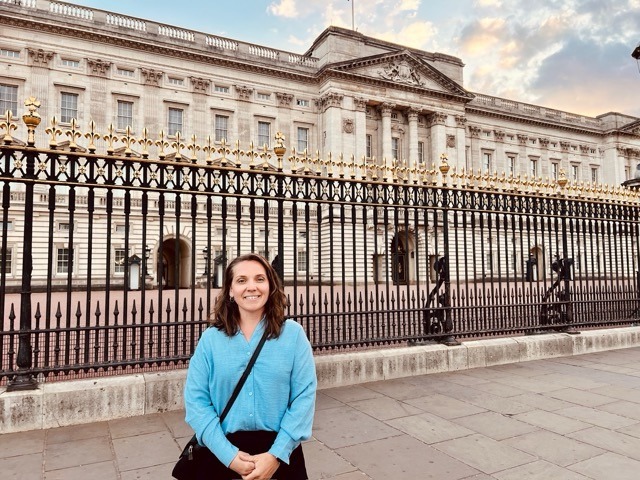
Heavy periods also affected virtually every practical part of my life. We planned our wedding and almost every family vacation around my cycle. I always wanted to know where the nearest bathroom was and whether I could get home quickly. The lighthouse picture above might seem random, but I remember visiting this specific lighthouse with my family on the day this photo was taken and realizing I was leaking through EVERYTHING.
I tried various forms of hormonal birth control. Some caused continuous or breakthrough bleeding; others had a significant impact on my mood and how I felt physically.
I also tried an IUD. The insertion was excruciating, I bled or spotted almost constantly for a year and a half, and my body eventually expelled it.
By 2022, I was ready to have a hysterectomy. In fact, I was gowned and waiting to enter the operating room when I tested positive for COVID and the surgery was cancelled.
After consulting with another OB/GYN, I decided to try an endometrial ablation first. It was much less invasive, and because I had considerable scar tissue and bladder adhesion from two C-sections, it presented fewer risks in my particular situation.
You can read the complete story of my heavy periods and why I decided to have an endometrial ablation.
Did My Periods Stop After an Endometrial Ablation?
No.
For some people, an ablation eliminates periods completely. That did not happen for me.
A year after the procedure, I was still bleeding for five to seven days each month. The important difference was that I was losing a tiny fraction of the blood I had lost before surgery.
Now, three and a half years after my ablation, my periods are even lighter.
They do not dictate my schedule. I no longer arrange vacations and special events around my cycle. I am not constantly worried about leaks or trying to remain within sprinting distance of a bathroom.
It is difficult to overstate the difference this has made. At this point, I only need a menstrual cup—without a backup pad or even pantyliner!!—which would have been completely and utterly unthinkable before.
Do I Regret Having an Endometrial Ablation?
Not at all.
Would I prefer never to have another period? Sure.
But eliminating my periods completely wasn’t the only possible definition of success. My real goal was to stop losing an extreme amount of blood every month and to prevent menstruation from controlling my life.
The ablation accomplished that.
I knew when I had the procedure that the improvement might not last until menopause. Heavy bleeding could eventually return, and I may still need a hysterectomy at some point.
For now, I’m not borrowing trouble.
I have already had three and a half years with very light, manageable periods. Even if I need another medical intervention eventually, that will not erase the value of the relief I have experienced.
What I Would Tell a Friend Considering an Ablation
The first thing I would say is that an ablation does not have to eliminate your periods to make an enormous difference.
I would also suggest asking your doctor:
- What’s causing my heavy bleeding?
- Am I a good candidate for an ablation?
- What outcome is realistic in my particular case?
- What are the risks and expected recovery?
- What contraception will I need afterward?
- What are my options if the heavy bleeding eventually returns?
Most importantly, I would remind a friend that my positive experience is only one experience.
I know women who have had excellent long-term results. I also know women who eventually needed hysterectomies.
My story is not a promise about what will happen in someone else’s body. But I remember how difficult it was to find detailed accounts from real people when I was weighing my options, and perhaps this will help someone feel a little less alone.
My Endometrial Ablation Results: The Short Version
When did I have an ablation? February 2023.
Did it stop my periods? No.
What was recovery like? There was quite a bit of cramping for the first few days—and a lot of discharge for the first few weeks.
What are my periods like now? Very light and manageable.
Has the bleeding increased again? No.
Do my periods still affect my daily decisions? Very little.
Do I regret having an endometrial ablation? Not for a second.
Your turn:
- Have you had an endometrial ablation? Is there anything you wish you had known beforehand?
Please only share what you feel comfortable discussing! Menstrual health can feel enormously isolating, and I hope this can be a kind and supportive place to talk about it.
Discover more from The Optimistic Musings of a Pessimist
Subscribe to get the latest posts sent to your email.


I have never heard of endometrial ablation! But it’s really interesting to learn about it and how it worked for you.
It must have been such a relief not to have periods dictating your life anymore!
That “raw chicken juice” comparison, haha! I can absolutely see why you included that, because sometimes the information you desperately need is exactly the TMI that nobody dares to mention!
My periods were bad as a teenager, especially the cramps on the first day. However, it got better later on. When I got married, I went on hormonal birth control, which made everything so much easier. My periods were lighter and didn’t stand in the way of big events, even marathon races.
It has been a major life shift!
I’m so glad that the hormonal birth control did the trick for you!!!
I wish OCP would have fixed the issue for me; unfortunately, they created so many problems. My body just did not respond well to hormone shifts (and I tried A LOT of different things). That is definitely the logical place to start, though, and over a series of literal decades I tried almost a dozen different kinds!!!
It sounds like the ablation procedure was life changing for you. How interesting to read about it and I am sure sharing the TMI bits will really help someone in the future. Things like this are not talked about enough. Thank you for sharing.
It’s definitely something that can feel incredibly isolating; it’s this life-altering issue that happens every single month and yet it largely invisible to everyone around you!
So I’m happy to share.
I remember when you had that and I remember when you first talked about your period, because I was like “what.” Those periods you had were absolutely off-the-charts! But I guess that would have been “normal” for you as how do you know your period is not normal when it’s what you’ve had since you started menstruating? But wow, what a burden. It reminds me about how old-timey ladies would call it The Curse. I can’t imagine how stressful it would be to go through life that way, always worrying about the nearest bathroom, etc. I am so glad the ablation was a positive experience for you. I have known a few women to have it – some still had light periods, some not at all.
My periods were heavier when I was younger, but in no way would they have compared to yours. No wonder you were exhausted! You poor thing. Now my periods are perimenopausing – so they are here and there, but in general they are so light I might need 2-3 pantyliners a day AT MOST. So, basically it’s a big nothing.
Off-the-charts is exactly how it felt. For YEARS! I would sleep inside a black plastic garbage bag when I was a teen (with the bottom cut out) so I didn’t leak onto my sheets. Of course, I would wake up DRENCHED in sweat. It was awful and it was very much a shameful (in a way) thing that I felt had no solution.
Hooray for light periods, whichever method we take to reach that point!
Thanks for this post – I think openness and honesty about menstrual health is so important, as it can sometimes be so hard to find. I’m so glad the ablation was successful for you and has had such a positive impact. I’m actually 7 weeks out from a hysterectomy (due to fibroids and adenomyosis) and, even though the procedure was tough and the recovery slow, I can’t tell you how delighted I am not to have to schedule trips away around my period or think about the clothes I’m wearing/potential leaking. So I completely understand that joy!
Thanks, Mary.
I wasn’t opposed to a hysterectomy and am open to perhaps needing one in the future (ablations aren’t a long-term solution, and I’m not even 40 yet, so it might not see me through to menopause), but I was glad to be able to postpone it just a bit.
All the best with your recovery and ENJOY all the time ahead of not worrying about leaking and disrupting daily life. It is such a difficult burden to bear, and mostly silently. I’m so happy you’ve found relief <3
I have no medical knowledge of this outside my own experience, but I’m surprised a doctor didn’t recommend a d and c at one point. I’ve had three over the years (one for miscarriage, two for heavy bleeding. The last also included an ablation. Though now that I’m writing this I’m realizing perhaps with your procedure being recent, doctors go straight to the ablation and skip the d and c. That second one I had didn’t do much of anything…).
Hmm. I’m not sure! They never suggested a D&C for me, but I think that would be more temporary than an ablation (you can have children after a D&C, but can’t after an ablation)?
I didn’t have my ablation until I was past child-bearing stages (well, mentally, not physically!), so it likely made sense to go for the more invasive procedure? But this is a great point and thanks for sharing as I’m sure there are lots of women struggling with heavy periods or fibroids that want some relief AND want to leave the door open for having children.
I’ve never heard the phrase “menstrual health” before, and it needs to be in wider use. No one should have to plan their life around their period, but I think it happens so much more than we realize.
In my own case, I am very grateful that oral contraceptives not only took care of contraception but also 99% of my annoying period symptoms. I take the pill continuously, so I never have a period and it is wonderful. I know that it’s not the right option for everyone, and I had to try a few different pills before I found the one that was compatible with my personal chemistry. There is no one size fits all option when it comes to women’s health.
“No one should have to plan their life around their period, but I think it happens so much more than we realize.” Yes! I am sure if men had their “monthly” the world would be arranged much differently to accommodate it!
Hooray for OCPs working the right way. You’re so right about personal chemistry. I tried a lot of options and none worked for me, but it’s the first thing to try for most people and it definitely requires patience to test things out.
I’m SO GLAD that you had this procedure and that it worked so well for you! Your life before this sounds pretty miserable. You must also feel so much better now that you’re not losing so much blood! You must have been constantly anemic.
I think I’m the oldest commenter here so far, so I just want to mention- MENOPAUSE! It really gets a bad rap. I don’t miss my periods ONE LITTLE BIT. It’s awesome.
Jenny, I am SO GLAD, too! It worked so well. I’m sure that is not the case for every woman and I am obviously an n = 1 sample size. BUT, I wish I had a “real” story like this to read when I was researching options.
I cannot wait for no more periods. The clock is ticking for me and I am thrilled.
Yay! It’s good to hear a positive story about women’s health care. I…do not have many of those. I hope this post comes up if someone’s searching for other people’s experiences with ablation.
You highlight something I neglected to write about in my post (maybe I did in the previous one): I had great care from very compassionate providers. That is not always the case. I was also fortunate that I worked with women; while I have no doubt many male practitioners do wonderful jobs in this career field, having a range of women working with me over the years (exclusively in my case) put me at ease in a different way.
I can’t believe this was three years ago already. I remember you in the decision making process. I’m So happy it was the right choice and you’re feeling better! I’ve had suggestions from Drs to do an IUD because of my chronic illness hormonal stuff. I’ve heard some less than great stories tho. Ummmm…. Okay well…. maybe some down right horror stories. I feel like if this was a male procedure in kind there would be sedation of some sort and probably bed rest afterward. 😂
It’s great that women are more open to talking about their health now a days. Hopefully this continues, more research, more discussion for the up and coming generations.
Time flies! I can’t believe it either.
I know a few horror stories from IUD and a few “I LOVE MY IUD SO MUCH” and it’s hard because there are always going to be different experiences. For me, it was a gut that I was completely done with trying anything short of medical intervention by way of surgery.
I know I am tremendously fortunate to live in an age where there is less shame surrounding something that HALF THE POPULATION GOES THROUGH MONTHLY and that there are advances in medicine that make dealing with these issues far more accessible than in generations past.
I appreciate you talking about this! I remember reading your state of the uterus address 😄 – it was the first time I had heard of a uterine ablation (and I’m a nurse!!)
I also have had very heavy periods, which got worse after having kids. Last year I finally found a provider who was compassionate and could give me some options- I strongly considered an ablation but ended up on oral medication for menorrhagia, which I take only on the heaviest days of my period. It has worked really well for me and I no longer have period stress about bleeding through out in public or overnight!! So I can definitely relate to the relief and improved quality of life!
Hooray! I’m so glad you found relief; I’m curious what the medication is called? I did take VERY strong doses of NSAIDs at one point because that has been shown to help but it didn’t help enough and also didn’t feel sustainable for me (and OCPs just did not work with my body’s chemistry).
I was also blissfully unaware of an endometrial ablation though I do have a vague recollection of you mentioning it awhile ago in a blog post. Thanks for sharing – knowledge is power and perhaps someone reading this will have an aha! moment either for themselves or or someone they know.
Love this: knowledge is power! Yes, menstrual health is an underrepresented conversation (IMO) and I felt very isolated. Especially when I was younger. I feel honoured to be able to share about my journey and can only hope it helps someone, somewhere!
It’s called tranexamic acid- brand name is Lysteda, at least in the US. I’m also on progesterone for ten days of my cycle for breakthrough bleeding, because I was spotting for 5ish days in between heavy periods 🙃
Oh! I took that. As soon as I saw the name I was like: I’ve been on that! Unfortunately, it didn’t help me much. But I did try it for 6ish months at one point. I can’t believe I forgot about that.
Hi Elisabeth, I love your blog and your writing style so much. I’ve been reading for about a year and found you through The Frugal Girl (also a wonderful blogger). I’m so happy to hear that your endometriosis is better under control with the ablation and that you are able to better enjoy life. I can relate after a procedure for endometriosis called an excision surgery.
I wanted to mention about endometriosis excision surgery, and I hope this comment comes across well, but I feel like I really want to share what I learned from several doctors who are endometriosis specialists about ablations.
I have endometriosis (live in the USA) and I got very very lucky and found a specialist practice with a doctor who is quite well renowned in the field. For situations such as ours, she said the endometrial ablation can make things worse in the long run for many women and that excision surgery is the gold standard. I understand that in Canada the procedures have different names and there are multiple types of ablations. But overall, she said for quality of life, as well as the health of other organs that endometrial lesions can affect, the excision surgery is the best way to go.
It’s worth doing research on this, and even seeing what is available with your national health insurance. I don’t say this to preach but just so that more women can know about their options if they, too, suffer from terrible periods and endometriosis symptoms (stomach issues, fatigue, etc).
Thank you so very much for sharing!! Knowledge is power and I think women need access to learning about ALL the options.
And here is where I admit I know there are various types of ablations and I actually have NO idea what kind I had…
I’m so very happy you have found lasting relief and I hope this comment is seen by other women who are researching the options.
Three and a half years!! I remember reading about your experience in real time and also can’t believe it’s been that long. I echo what other commenters have said about the importance of bringing this to light. The detail about sleeping in the black garbage bag just broke my heart!! I can’t tell you how many of my patients just assume their heavy periods are normal or unescapable — during regular physicals I always ask “are there any problems with your periods?” and 90% of the time, women say “no”. I always follow up with: “any heavy bleeding? do you pass clots?” and SO MANY of those same women say “well, yes”. *When it’s all you’ve ever known it’s hard to grasp where things fall on the spectrum of normal. I’m so glad you found a good solution that worked for you and I hope it gives you reprieve all the way through til menopause!
We’re used to downplaying the symptoms and living with them and suffering in silence. There is still at least a subconscious undercurrent of shame, too, I think. Which is so sad.
Kudos to you for gently pushing women for more information and for, I’m sure, telling them that they don’t have to suffer without help (and hope).
I am also hoping this bridges the gap to menopause!
I am so grateful for you sharing this, and that it’s becoming more common for women to talk about their experiences. Now for women to be believed straight up. Some of the things you’ve been through, wow.
Thanks for your honesty, vulnerability, and most likely, the help that you have provided women going through similar experiences.
I really appreciate you writing about this topic, especially how things have been AFTER the procedure. My periods aren’t AS bad as yours were, although I don’t exactly know how much blood I’m losing every month. I do know that my ferritin is dangerously low if I’m not on iron supplements and *just* at normal when I am (although it’s still low, in the 20s). And I find it so hard to make plans during those first few days of my period because I know I’m just going to be a murder scene every other hour, which is so annoying. Hoping to get my ablation done by the end of this year!
I hope you have a positive result Stephany, and praying for some easing of your symptoms in the meantime. It can be very all consuming and… NO FUN.
I’m so glad you had such a positive result from this! How lovely to not have your days ruled by your period any longer.
I believe I had similar periods to yours; horrid. Took me down several days each month. I felt like I was hemorrhaging. I had several D & C’s (3), and my doctor actually spoke about doing an ablation at one point….
I finally had a full hysterectomy after menopause started, and I have never been happier!
I likely wouldn’t have regretted a hysterectomy if it had happened (and I was SOOOO close to having it done… gowned and ready for the OR when I tested positive for Covid, womp, womp), but I am still a way from menopause and so the ablation seemed like a good middle ground.