



Updated July 2026
Ever visited a place where—and you couldn’t quite put your finger on why—it felt a bit like meeting a new best friend?
That sensation when you just know you’re going to hit it off and will end up talking about that person or place until you meet again.
If you’ve never had this experience, might I suggest a visit to Cape Sable Lighthouse?

We’ve visited a lot of stunning places in Nova Scotia, but Cape Sable captured our hearts like few others before or since. There’s a special magnetism about the island that’s hard to describe.
Cape Sable Lighthouse is the tallest lighthouse in Nova Scotia and can only be reached by boat. Our family adventure included empty beaches, grazing sheep, shipwreck remains, and enough washed-up buoys to make the children feel as though they had landed inside an enormous treasure hunt.
Table of Contents
Cape Sable vs. Cape Sable Island
First, the geography—and the terminology—can be a bit confusing.
Cape Sable Island is connected to mainland Nova Scotia by a causeway. You can drive across the causeway and explore communities including Clark’s Harbour and The Hawk.
Cape Sable is a separate, smaller island located just offshore. This is where Cape Sable Lighthouse stands, and it’s only accessible by boat.
And neither should be confused with Sable Island, the remote national park famous for its wild horses. Nova Scotia apparently enjoys keeping visitors on their toes!!
Cape Sable is at Nova Scotia’s southernmost tip, surrounded by notoriously rough and foggy waters. It feels remote, windswept, and almost entirely untouched.
Planning Our Trip to Cape Sable Lighthouse
Since having kids, we’ve made it a family mission to visit as many Nova Scotian lighthouses as possible.
We’re fortunate to live in a province with a seemingly endless coastline, giving us a plethora of lighthouses to choose from. Cape Sable still ranks among our five favourite lighthouses in Nova Scotia.
But before this particular adventure, we had always kept both feet on terra firma.
When I happened upon photographs of Cape Sable a few years earlier, it felt like the missing feather in our proverbial cap. Unfortunately, it was also tantalizingly out of reach.
Not ones to shirk from a challenge, three days later we found ourselves groggily loading life jackets and a picnic lunch into the trunk of our car at 6 a.m.
When adventure calls, beauty sleep can wait.
How Do You Get to Cape Sable Lighthouse?
Our first task was arranging transportation.

I scoured obscure internet message boards looking for contact information for someone who could get us safely across the channel. There isn’t exactly a glut of water taxis in the area.
When I called the only promising number I could find, I reached the wife of a retired boat operator.
While her husband was no longer able to shuttle people to the island, she—in characteristic Maritime jovialness—spent 20 minutes thumbing through her phone book until she tracked down someone who could.
A few more phone calls (and some map and weather consultations) and we were headed to Cape Sable.
There’s no bridge or regular passenger ferry to the lighthouse. The availability of boat transportation can change, and trips depend heavily on weather and sea conditions.
The Municipality of Barrington’s Cape Sable Island page is the best place to check for current information about Cape Days and organized boat rides to the island.
Even if you can’t arrange a crossing, you can see Cape Sable Lighthouse from The Hawk Beach on Cape Sable Island. The Hawk is worth visiting in its own right, with a long white-sand beach and a 1,500-year-old drowned forest that’s visible at low tide.


Arriving at Cape Sable Lighthouse
The boat ride across was short, chilly, and thrilling.
There’s something especially dramatic about approaching a lighthouse by water. Instead of pulling into a parking lot and strolling toward it, we watched this enormous white tower rise above an almost entirely undeveloped island.
It immediately felt like a proper adventure.


The History of Cape Sable Lighthouse
The waters surrounding Cape Sable have long been notoriously treacherous.
On February 20, 1860, the SS Hungarian was wrecked on the Cape Sable ledges. More than 200 people lost their lives, and the tragedy prompted the government to construct the first Cape Sable Lighthouse, which was completed in 1861.
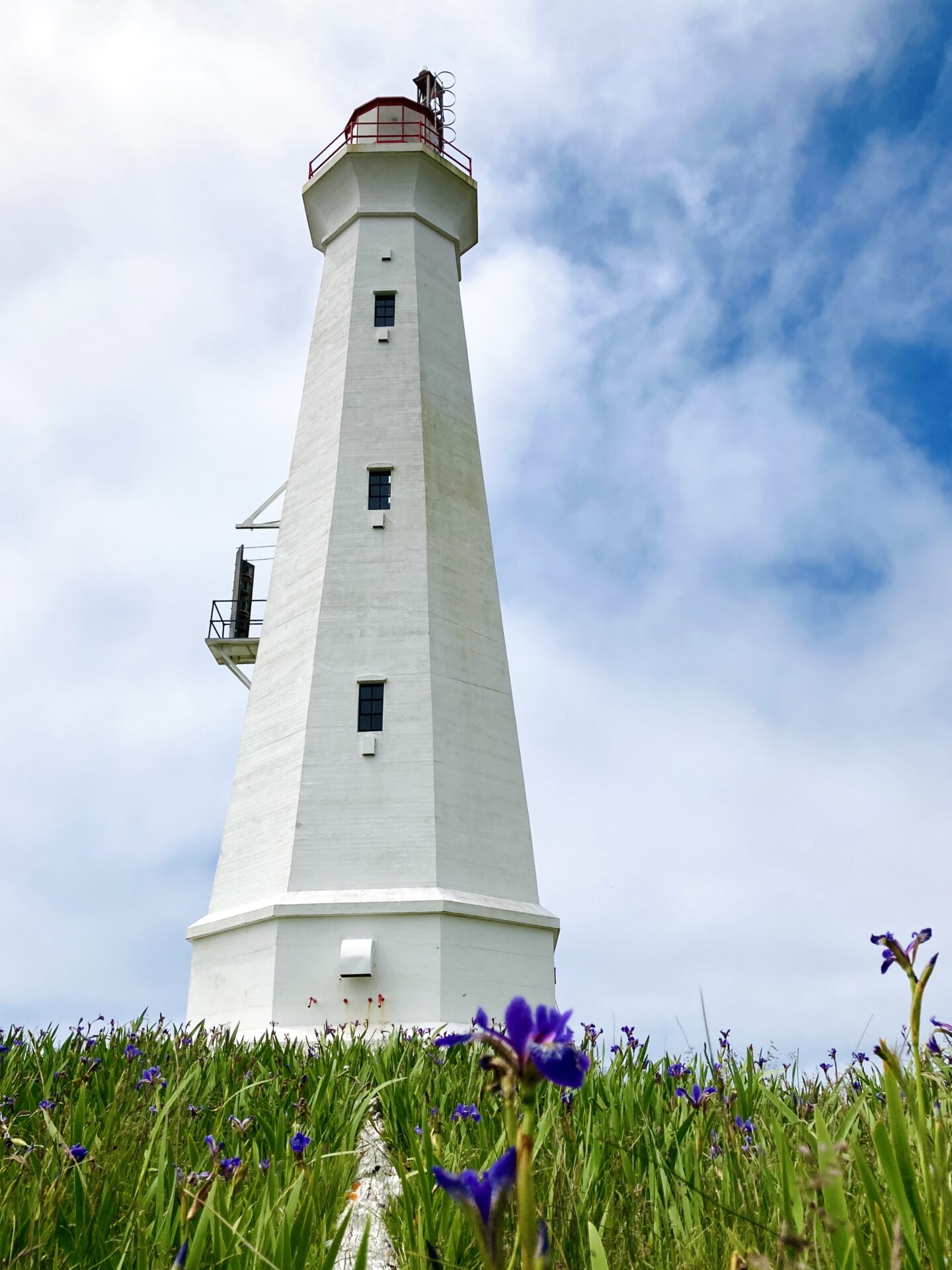
The present lighthouse replaced the earlier wooden tower in 1923. It’s an octagonal reinforced-concrete structure standing approximately 30 metres—or 101 feet—tall.
Which makes Cape Sable Lighthouse the tallest lighthouse in Nova Scotia. (It’s also a Classified Federal Heritage Building because of its unusual design, historical importance, and prominent position near the entrance to the Bay of Fundy.)

The lighthouse was automated during the 1980s, and the former keeper’s house was eventually demolished. The lighthouse tower itself remains an active and important coastal landmark.
The outside of the tower and the surrounding landscape are the attractions here; visitors should not arrive expecting a lighthouse tour or a climb to the top.
Wild Beaches, Lobster Traps and Purple Irises
Cape Sable has character in spades.
Long white-sand beaches stretch empty as far as the eye can see. Other sections of the shoreline are covered in smooth grey stones, driftwood, buoys, and fishing gear carried in by the Atlantic.
Unmoored lobster traps form what looks like a permanent outdoor art installation.


The beach on Cape Sable reminded me why Nova Scotia’s coastline is so special. It isn’t necessarily the sort of beach where you spread out a towel, apply sunscreen, and spend a peaceful afternoon swimming.
It’s a beach for wandering and exploring to see what might have washed ashore overnight.
We have visited many of the best beaches in Nova Scotia, but Cape Sable feels completely different from any of them.
There were also beautiful purple irises growing around the lighthouse. The combination of wildflowers, white tower, rocky shoreline, and crashing Atlantic waves was almost absurdly photogenic!

The Sheep of Cape Sable
Sheep are placed on the island seasonally to graze.
It provides food for the sheep, and no one has to mow the grass on Cape Sable. A mutually beneficial arrangement!

We ate our picnic lunch in the shadow of the lighthouse while flocks of sheep bleated in the background.
I’m not sure what the children had imagined we would discover on this trip, but I suspect “a deserted island covered in sheep and free outdoor toys” exceeded expectations.

After lunch, we canvassed the beach for treasures. We came home with a collection of old buoys for the trees in our backyard.


Meeting the Son of a Former Lighthouse Keeper
Aside from the sheep, we encountered only one other living presence on the island: the son of a former lighthouse keeper, who maintains a small cottage there.
He gladly put down his paintbrush, welcomed us into his cabin, and started sharing the history of the lighthouse and his experiences growing up on Cape Sable.
And then he mentioned the word “shipwreck.” Two sets of little ears immediately went into full-alert mode.
He grabbed a container from the windowsill and showed the kids pottery fragments recovered near one of the wreck sites. He had a very eager audience.
Exploring Shipwreck Remains on Cape Sable
By this time, we were starting to wind down our day.
Our guide, who had left us to explore for several hours, returned and meandered with us toward the boat.
En route, we stopped at a small inlet where he pointed out shipwreck remains. Sections of the wooden structure were still held together with wooden pegs rather than iron.


Giant Buoys
We climbed onto enormous navigation buoys that had washed ashore, though these were a bit too big to bring home as souvenirs.
It was the sort of destination where the landscape provided all the entertainment we needed.
No gift shop. No playground.
Just a lighthouse, a beach, sheep, shipwreck stories, and miles of room to explore.

The kids even used giant lobster claws as pencils and played Pictionary in the sand.

Is Cape Sable Lighthouse Worth Visiting?
Absolutely—though getting there requires more planning than visiting a typical Nova Scotia lighthouse.
Cape Sable is melancholy and beautiful in its own stunning way. It feels remote without being impossibly distant, and wild without being completely inaccessible.
We can’t wait to return for another visit.
Tips for Visiting Cape Sable Lighthouse
Here are a few important things to know before planning your own Cape Sable adventure.
You Need a Boat to Reach the Lighthouse
You can drive across the causeway to Cape Sable Island, but Cape Sable Lighthouse is located on a separate island.
There is no regular passenger ferry. Check the Municipality of Barrington website for current information about organized boat trips and Cape Days.
Do not make a special trip based on old contact information found in a blog post or online forum. Local transportation arrangements can change!!!
Boat Trips Are Weather-Dependent
Cape Sable is exposed to the Atlantic Ocean, and conditions can change quickly.
Boat operators may need to cancel or postpone trips because of wind, fog, tides, or rough water. Build some flexibility into your plans.
You Can See the Lighthouse From Shore
You don’t have to take a boat to see Cape Sable Lighthouse.
The lighthouse is visible across the water from The Hawk Beach, located on Cape Sable Island.
Pack Everything You Need
Cape Sable itself has no visitor centre, cafe, gift shop, or public facilities.
Bring:
- Food and drinking water
- Layers and windproof clothing
- Sunscreen and a hat
- Sturdy or waterproof footwear
- Any medication or other essentials you may need
- A bag for carrying out your garbage
I would also bring more food than you think you’ll need. Something about salt air and island exploration makes everyone ravenous.
Respect the Island
Cape Sable is a fragile natural and historical environment.
Give grazing sheep plenty of space, carry out everything you bring, and leave shipwreck fragments and other historic materials where you find them.
Frequently Asked Questions About Cape Sable Lighthouse
Can You Drive to Cape Sable Lighthouse?
No. You can drive to Cape Sable Island using the causeway, but Cape Sable Lighthouse stands on a separate island that is accessible only by boat.
Can You See Cape Sable Lighthouse Without Taking a Boat?
Yes. Cape Sable Lighthouse can be seen across the water from The Hawk Beach on Cape Sable Island.
Is Cape Sable the Same Place as Sable Island?
No.
Cape Sable is located just off the southwestern tip of mainland Nova Scotia. Sable Island National Park Reserve—the remote island famous for wild horses—is approximately 290 kilometres southeast of Halifax.
How Tall Is Cape Sable Lighthouse?
Cape Sable Lighthouse is 101 feet tall, making it the tallest lighthouse in Nova Scotia.
When Was Cape Sable Lighthouse Built?
The first Cape Sable Lighthouse was completed in 1861 after the wreck of the SS Hungarian. The current reinforced-concrete lighthouse was constructed in 1923.
Can You Go Inside Cape Sable Lighthouse?
Visitors should not expect to enter or climb the lighthouse. The appeal of a Cape Sable trip is exploring the lighthouse grounds, beaches, and surrounding island.


Your turn. Have you ever visited an off-land lighthouse? Does looking back at your kiddo’s baby/toddler pictures make you clutch your heart – unless of course you’re still in the throes of infancy and toddlerhood!
Discover more from The Optimistic Musings of a Pessimist
Subscribe to get the latest posts sent to your email.


I’ve done school author visits in Clark’s Harbour, but I’ve never been to the island of Cape Sable. The pictures are so great, and what an adventure for your family. I’ll be visiting the area again in April for a school visit – I remember the beaches across the causeway being spectacular.
I had never even heard of the island until a few years ago. But it’s beautiful! Apparently they used to have “island” days where they would have a water taxi service and shuttle all sorts of people out to the island to explore. That was pre-COVID of course.
Friends of ours learned about the island from our adventure and actually ended up camping there for two nights later that same summer! I’m not sure I’d want to stay overnight, but it was one of the most beautiful places I’ve ever visited.
What an incredible adventure- a near-deserted island with sheep, an old shipwreck (!) and meeting the son of a former lighthouse keeper. Does that guy live there year-round? I’m fascinated at the thought of him there all by himself.
Anyway… I have a little surprise for you, which is that I visited a local lighthouse yesterday!!! I’m going to write about it on the blog next week- I really loved it. I can’t wait to share it!
He doesn’t live out there year-round; he and his sister share using the space in the summers and he just boats out when he wants to get away from life on the mainland! I don’t think I’d want to be alone on a biggish island by myself, but I suppose if you grew up there, it would be normalized?
YOU WENT TO A LIGHTHOUSE??!! Oh Jenny, you know I am setting up a countdown for your post. This makes me very happy <3
OOOOH this is right up my alley and I want to go there soooooo bad. I feel like someone could go to Cape Sable many times and never run out of things to see and stuff to do.
My closest equivalents are the lighthouses on Pelee Island and Put in Bay. Another honorable mention is the Lorain Lighthouse which is only accessible by boat, and it’s a stand alone building in Lake Erie. I’ll get around to writing a post about it someday.
Agreed about visiting again – I want to go this summer; it has been a few years and the kids are a lot older/bigger. Part of me is scared that we’ll never be able to recreate the “magic” of that first visit, but I’m itching to get back out there. I think you would LOVE it!
The photos are stunning! What an interesting place to visit. I love to travel along with you. The only lighthouses I remember visiting are the points of PEI: on one of our visits, Mom and I did the point-to-point and got certificates for the achievement! But no boat needed to get to those.
The PEI lighthouses are classic! It’s incredible how many lighthouses are on the island. It’s very impressive to get to the ones at opposing tips so gold stars to you!
Wow, what a unique adventure! Definitely “off the beaten path” that most tourists would never get to see! Love places like that. What a wonderfully charming day! How cool to get invited in to learn about the history. I feel like lighthouse keepers are a unique and solitary type of person. I also loooove lighthouses. WHEN I come visit you someday, I hope to see some of these. 🙂
Yay! I’m holding you to that promise, Kae 🙂
The photos remind me of the West and North coasts of Scotland, which we love to visit. Lighthouses at the Mull of Kintyre, Butt of Lewis and Mull of Galloway to name a few. And white sand beaches as far as the eye can see, completely deserted, and a cold, cold sea. I remember standing on beaches in the Outer Hebrides and also in Connemara on the West Coast of Ireland and looking at the Atlantic ocean and thinking ” next land, Canada!”. I’d love to visit Eastern Canada one day and your photos really inspire me, so thank you.
Well, I want to visit Scotland so we should just do a switch 🙂
(The Mull of Galloway lighthouse looks especially beautiful!)
Wow, what a cool adventure, Elisabeth – for both kids, and adults alike! I’d totally love to make such a day trip. The island looks so picturesque!
What a beautiful area to visit! You live in such a gorgeous area that has so much to offer. We are so far inland so don’t have the ability to visit light houses! There are some on the north shore of Lake Superior but it’s a different vibe from what you have in your neck of the woods.
I’m still in the throws of toddler parenting so I don’t quite have that heart clutching feeling yet. I do get some nostalgia when I look back at photos of the kids as babies and young toddlers. But those years don’t feel so far off… yet!
Yeah, I didn’t heart clutch at your stage, either. It’s not that I MISS that age (really), more just nostalgia for how little they were. It’s a bittersweet part of parenting but, as you know, I tend to prefer the older ages even though that form of parenting has it’s own challenges.
You live in such a beautiful area. I’d love to see this part of the world myself. Until then I live through your images. So keep them coming please.
<3 Will do!
I recently found an OLD guidebook (printed, no less) for PEI and Nova Scotia, from a long-ago planned trip that was, unfortunately, derailed by that thing we call “life”. Sigh. What does it say about me that I kept it, despite its clear irrelevance to my life right now? (I mean, *obviously* I’d be consulting the experts, and finding out about such exquisite gems as the Cape Sable lighthouse… duh. ;>)
Thank you for sharing more of the beauty of Nova Scotia. <3