


If you’re staying in Vienna and want an easy international day trip, Bratislava is one of the simplest options. Slovakia’s capital is only about an hour away by direct train, and the compact Old Town makes it easy to see most of the major Bratislava attractions in a single day.
In Canada, we can drive for hours and still be in the same province. From Vienna, we could travel for an hour and end up in an entirely different country.
Obviously, we were going to capitalize on this!
A Bratislava day trip from Vienna checked several boxes: straightforward transportation, relatively inexpensive train tickets, a compact city centre, castles, churches, quirky statues, and the chance to add Slovakia to our list of countries visited.
Bratislava day trip at a glance:
- Travel time from Vienna: Approximately one hour by direct train
- Best for: Old Town, castles, churches, views, and unusual public art
- Getting around: Most central attractions are walkable
- Kid-friendly: Yes, though the walk up to Bratislava Castle is steep
- Our verdict: Easy and worthwhile, though not our favourite day trip from Vienna
How to Get from Vienna to Bratislava by Train
We travelled from Vienna to Bratislava using Austria’s national railway, ÖBB.
Direct regional trains run between Vienna and Bratislava regularly, and take about one hour. Depending on the train, you may arrive at either Bratislava Hlavná Stanica, the main railway station, or Bratislava-Petržalka. The official ÖBB information says REX trains generally run twice per hour. Here’s the official ÖBB Bratislava Ticket page.
The ÖBB Bratislava Ticket
At the time of our trip, the Bratislava Ticket cost €19 per adult and €9.50 per child. We weren’t able to buy these particular tickets digitally before our trip (still not sure why?), so we purchased them from an ÖBB agent at the train station. I’ve included screenshots of the ticket information below because it took me a little while to figure everything out.


This included:
- Return train travel between Vienna and Bratislava
- Public transportation within Bratislava on the first day of validity
- The flexibility to return to Vienna later in the day; it’s nice to not have to pick a specific return time
We didn’t end up using local transit (everything is walkable), but this ticket was still a great deal.
From the Wien Hauptbahnhof train station, it’s took us just under an hour to get to Bratislava. You barely get settled on the train before you’re already crossing into another country!

Also, THERE ARE FREE BATHROOMS ON THE TRAIN. This became relevant because most public bathrooms we encountered in Bratislava required payment. Such is travel in Europe. Never underestimate the value of carrying a few coins—or using a free train bathroom when one presents itself.
Bratislava Day Trip: Quick Planning Tips
- Currency: Slovakia uses the Euro!
- Language: The official language is Slovak, though we didn’t have any trouble navigating the main tourist areas.
- Transportation: Central Bratislava is compact, and we walked between almost all the major sights. Public transportation is available, but we didn’t need it. The Visit Bratislava transportation guide has current information about buses, trams, tickets, and validation.
- Shoes: Wear comfortable footwear. The Old Town is easy to explore on foot, but the walk to Bratislava Castle involves a noticeable hill.
- Bathrooms: Keep coins handy!!
A Brief History of Bratislava
Bratislava became the capital of the Kingdom of Hungary in 1536, after Ottoman expansion made the former capital less secure.
It later became an important coronation city. Between 1563 and 1830, Hungarian kings and queens were crowned at St. Martin’s Cathedral. That history shows up everywhere—from the crown at the top of the cathedral tower (see below!), to the city’s ornate palaces and winding streets.
Best Things to Do in Bratislava in One Day
Here are the main attractions we managed to visit during our Bratislava day trip from Vienna.
St. Martin’s Cathedral
One of our first stops was St. Martin’s Cathedral, one of the most historically significant buildings in Bratislava. This is where those Hungarian coronations took place!


Look up and you can (kind of) see a gold crown on top of the tower, marking the importance of the site.
We went inside St. Martins but couldn’t take photos (a mid-day mass was finishing). Still, it’s worth stepping inside if you can.
The cathedral’s exterior is relatively understated compared with some of the ornate churches we visited elsewhere in Europe, but the scale and historical significance are impressive.
The Blue Church
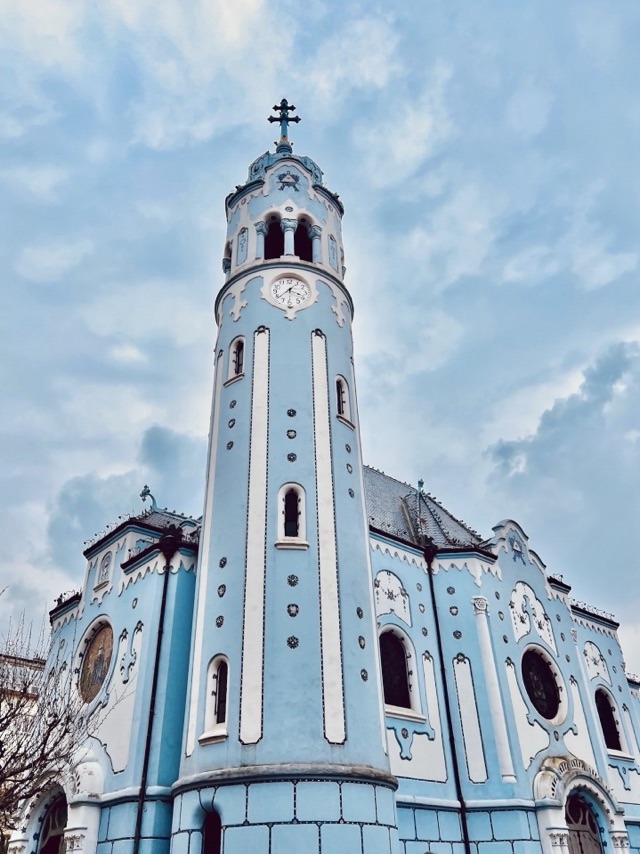
From there, we walked to the Blue Church, officially called the Church of St. Elisabeth. Okay—this one is wild.


It’s completely blue. Not “kind of blue.” Not “blue accents.” Everything is blue. (Even the inside.) The walls are blue. The decorative trim is blue. The roof has blue tiles. The interior is blue and white.
It was one of the prettiest and most distinctive buildings we saw in Bratislava. To me it looks like something out of a fairytale!
Also, it was a personal highlight because apparently I will never fail to get excited at seeing “Elisabeth” spelled with an s!
Bratislava Castle
We decided to visit Bratislava Castle relatively early in the day. (I prefer to get the cardio suffering over with as quickly as possible.)
The castle sits on a hill overlooking the city and the Danube River, so reaching it involves a steady uphill climb. It wasn’t awful, but it certainly wasn’t flat.


The present castle has undergone plenty of reconstructions. After a major fire in 1811, it stayed in ruins for more than a century before extensive rebuilding efforts.
We didn’t tour the museum, but the castle grounds and terraces were free to explore and offered some of our favourite views of the day. We also stopped for a picnic lunch on the grounds.
Views of the UFO Bridge
From Bratislava Castle, we had an excellent view of the Danube and the distinctive UFO Bridge. Officially called Most SNP, the bridge has a flying-saucer-shaped observation deck perched above one end. The UFO observation deck offers panoramic views over Bratislava, though we were content to admire it from the castle grounds.
It’s certainly not subtle.


Fun fact: the SNP refers to the Slovak National Uprising (1944) against Nazi-aligned leadership.


There were archaeological ruins nearby, which Indy immediately converted into an obstacle course. Why merely look at ancient stones when you can leap over them???
St. Michael’s Gate and Tower
This is one of those spots you’ll almost definitely walk through without realizing how old it actually is.
Michael’s Gate is the only surviving medieval gate from Bratislava’s original fortifications. It dates back to the 1300s, when the city was fully walled and you actually had to enter through gates like this!!!


At some point, it got a makeover (hence the green copper roof), but the bones are still medieval.
You can go up the tower. There’s a small museum inside and some great views of the old town. I think it’s only a few euros (something like €5-ish for adults), so pretty reasonable if you want a higher vantage point without climbing all the way back up to the castle. We didn’t end up climbing to the top because the kids said they weren’t too interested, but it could be fun!
Primate’s Palace
I’m still not clear on what the actual name of this palace is… some sources it says Primatial Palace, other places it’s listed as Primate’s Palace (and then all I can think about are monkeys).


Anyway, it is aggressively PINK.
You can go inside to see the Hall of Mirrors (where Napoleon Bonaparte signed a peace treaty*) for an entry fee, but we only took in exterior views.
* I looked this up: it was the The Peace of Pressburg—also called the Treaty of Bratislava—and it was signed in the Hall of Mirrors in 1805 after Napoleon’s victory at the Battle of Austerlitz.

There was also an enormous whimsical bicycle contraption outside. I originally assumed it was some sort of art installation, but readers later informed me it is, in fact, a bike rack.
Practical public art. I approve.
Bratislava’s Famous Statues
If I had to pick my favourite part of exploring Bratislava, it was definitely the statues!
You’ll just be walking along and suddenly—
Čumil
The most famous is Čumil, a bronze figure peeking out of a manhole. His name is often translated as “the watcher” or “the observer.” No one seems entirely certain what he is watching—or why he looks so pleased with himself.
He’s become one of the most photographed attractions in Bratislava. (Expect to find a lineup for photo ops.)


Napoleon’s Army Soldier
This one was my favourite.


It’s a Napoleonic soldier leaning over the back of a bench in the Main Square. The statue commemorates the presence of Napoleon’s army in Bratislava during the sieges of 1805 and 1809.
Schöne Náci
A gentleman tipping his hat.
Unlike some of the other statues, Schöne Náci was based on a real Bratislava resident named Ignác Lamár. He was known for dressing elegantly, greeting people in the streets, and handing flowers to women.
The kids enjoyed posing underneath his raised hat.


This was a random statue we saw but I couldn’t figure out a name…
Nevertheless, the kids were both keen to pose beside it. (It’s in the same square with Napolean’s Soldier.)


Wander Through Bratislava Old Town
Some of the best parts of our day involved wandering without a particular destination.
Bratislava’s Old Town has:
- Narrow cobblestone lanes
- Colourful historic façades
- Quiet courtyards
- Arched passageways
- Outdoor cafés
- Decorative plaques and statues
- Unexpected little architectural details


The central area is compact enough that you can wander freely without getting terribly lost.


We followed whichever streets looked interesting, admired the buildings, investigated courtyards, and took an unreasonable number of photographs.


Things We Didn’t Get to Do in Bratislava
A single day was enough to see many of Bratislava’s central attractions, but there were still a few things we missed.
Devín Castle
There’s a castle in ruins about 10 km outside the city where the Danube meets the Morava River. The views are supposed to be incredible and it’s included in the Bratislava transit ticket. Since we were only in Bratislava for the day, we decided to focus on the Old Town and Bratislava Castle instead.
Traditional Slovak Food
We also failed rather spectacularly at sampling traditional Slovak cuisine.
I had hoped to try bryndzové halušky, a dish made with potato dumplings, sheep cheese, and bacon. We were also interested in parené buchty, steamed sweet dumplings filled with jam.
Instead, we ended up at McDonald’s.
This was not a culturally ambitious decision, but it did provide food, warmth, and access to a bathroom.
Sort of.
The bathroom required a code printed on the receipt. We had ordered using a self-service kiosk, and our receipt did not initially print correctly. This led to an unexpectedly complicated series of events involving the bathroom door, the missing code, and increasing desperation.
Travel is always glamorous. NOT!
Is Bratislava Worth a Day Trip from Vienna?
es—but I also want to be honest.
We liked Bratislava. We did not love Bratislava.
It was easy to reach, inexpensive compared with many European capitals, and perfectly manageable as a day trip. We enjoyed the castle views, the Blue Church, the statues, and the Old Town streets.
But the weather was cold and overcast, and the city didn’t immediately sweep us off our feet.
A guided walking tour might have helped bring more of the history to life. Sometimes a city becomes much more memorable once you understand the stories behind the buildings and streets.
Still, the main purpose of our trip was to experience Slovakia, and I’m glad we went. Bratislava is very different from Vienna, and that contrast is part of what makes it a worthwhile excursion.
It is especially well suited to travellers who:
- Want an easy international day trip from Vienna
- Enjoy castles, churches, architecture, and historic streets
- Prefer compact, walkable destinations
- Like quirky statues and unusual public art
- Want to visit another European capital without complicated logistics
More Easy Day Trips from Vienna
Bratislava wasn’t the only international day trip we took while based in Vienna.
We also visited Brno, Czechia, which had colourful architecture, an excellent food scene, and a slightly livelier atmosphere.
Another easy option is Sopron, Hungary, a smaller and quieter destination with a charming medieval Old Town.
You can also browse our other family travel posts and European adventures.
Bratislava Day Trip FAQs
How long is the train from Vienna to Bratislava?
The direct train journey generally takes approximately one hour. Regional trains run regularly throughout the day, making it easy to travel to Bratislava in the morning and return to Vienna that evening.
Is one day enough for Bratislava?
One day is enough to see many of central Bratislava’s main attractions, including Bratislava Castle, St. Martin’s Cathedral, Michael’s Gate, the Blue Church, the famous statues, and much of the Old Town.
You will probably need more time if you also want to tour museums, visit the UFO observation deck, or travel outside the city centre to Devín Castle.
Is Bratislava walkable?
Yes. Bratislava’s Old Town is compact and highly walkable. Most major central attractions are within a relatively small area, although Bratislava Castle sits at the top of a hill.
Is Bratislava a good day trip with kids?
We found Bratislava manageable with kids. The compact centre, pedestrian streets, castle grounds, statues, and ruins offered plenty to look at along the way.
There is a fair amount of walking, so comfortable shoes and snack breaks are important.
Is Bratislava worth visiting from Vienna?
Bratislava is worth visiting if you want an easy, affordable international day trip with castles, historic streets, and a different atmosphere from Vienna. It may not have the grandeur of Vienna, but it is compact, distinctive, and easy to explore in one day.
And that’s a wrap.
- Would you take a day trip to another country if it was this easy?
- Which would you be more excited to see first: the castle, the quirky statues, or the fairytale-blue church?
Discover more from The Optimistic Musings of a Pessimist
Subscribe to get the latest posts sent to your email.


Ah, it looks like I will will add Bratislava to my future Vienna visit. Kai goes every year and he feels like you: it’s ok, but not exactly spectacular. Although I do love the vibe of the old town, especially the statues everywhere.
That McD policy is ridiculous! Imagine how many families only have one receipt! Perhaps even worth a pointed Google review comment… 😂
It’s a great day trip for sure, and I think doing a walking tour of the town would be really cool and there are lots of fun food options, too. I don’t think it would be hard to pass the time.
Dear Elisabeth,
the giant bike sculpture may be a particularly beautiful bike stand. It used to be (here in Germany at least) that kickstands weren’t very common on everyday bikes so that a bike stand near the ground helped balancing out parked bikes. Nowaday, and especially with ebikes, it ist recommended to fasten your lock much higher up so that bike thieves have a harder time sawing the lock. That made bike racks that go up as far as a bike’s top tube more popular.
So interesting and this makes so much sense.
Rob’s grandpa was from Slovakia so we will definitely be going to Bratislava someday – he wants to visit!
You went into more detail about that story before and it is fascinating (and sad). If you go to Slovakia, make sure to tack on a bit of time in Vienna. It’s beautiful!
The bike sculpture is a bike rack. I really enjoyed Slovakia and stayed in Bratislava for a few days. I found it to be a lot less expensive that Vienna so is a good place for geo arbitrage if you went the opposite, stay in Slovakia, day trip to Vienna. I really enjoyed the wine and had a very nice night chatting with the owner of a restaurant…who ended up giving us a bunch of local food to try. I was there in November and it was also cold and a bit rainy. I’m glad you got to check it out!
The reverse trip works, too!
I think I would find it hard to fill an extended time with the kids in Bratislava, but they had a great day and LOVED the statues.
This whole city seems quirky! I’ve never been there, but I think I would enjoy it. It seems perfect for a day trip. And the history from that part of Europe is fascinating.
To answer your question, I would be most excited about the statues (although I would want to see the other tings as well, of course). I would probbly go on a statue scavenger hunt around the city!
The statues were really fun. Quirky is exactly the right term and… I like quirky 😉
There is a story to the worker statue coming up out of the ground. It’s to pay homage to the workers, but I don’t know which ones or actually why. And something happened to him and he had to be replaced. There were a few others and fun to see.
The statues were really fun! If I had it to do over again I think I’d try to schedule a walking tour because that way I’d get a lot of the history of the city and probably plenty of fun facts about the statues 🙂
My mom’s family is from Slovakia so we would visit growing up and I also had the opportunity to work as an au pair there after college! It’s a beautiful country with wonderful castles and nature! You’ll definitely have to try more of the food next time you visit!
I’d love to see more of Slovakia some day; some of the castles look truly incredible!
What a fun day trip! If I were staying near a border, I would absolutely day trip over if it were that easy. When we were in the South of France we drove over the border into Italy, just to say we did and have pizza. We did not explore the towns much at all, you saw a lot more than we did. The blue church reminds me a bit of the Russian Orthodox churches I have seen.
It does look a bit like Russian Orthodox churches! The rounded almost plaster look makes me think of those churches.