

*This giveaway is now closed… but if you didn’t happen to win, you should definitely find a way to get your hands on this book!*
For Mother’s Day, I knew exactly what I wanted: a relaxing day spent alone (the key ingredient in my plans for relaxation) on the couch in our apartment.
There were two loads of laundry thrown into the mix because… needs must. But the rest of the time was deliciously mine. My husband took the kids while I luxuriated in those precious commodities called peace and quiet.
I sipped mint hot chocolate out of my new Moomin mug, took a long, scalding shower, and settled into a little cocoon of blankets and pillows to finish reading Laura Vanderkam’s newest book Big Time.
In other words, it was practically perfect.
I also felt like I’d spent this special day in a way that would make Laura proud. Some professional progress (I’m writing this book review up for my blog, after all), nurturing relationships (I admire Laura), and self-care (reading a great time management book happens to be my idea of a good time; obviously I’m the life of every party).
I’ll always have a special place in my heart for Laura’s work after being a participant in her Tranquility by Tuesday test group. “Three times a week makes a habit” was the final nudge I needed to create an online space to call my own. In a way, she’s the very reason you’re reading this blog post today… about her.
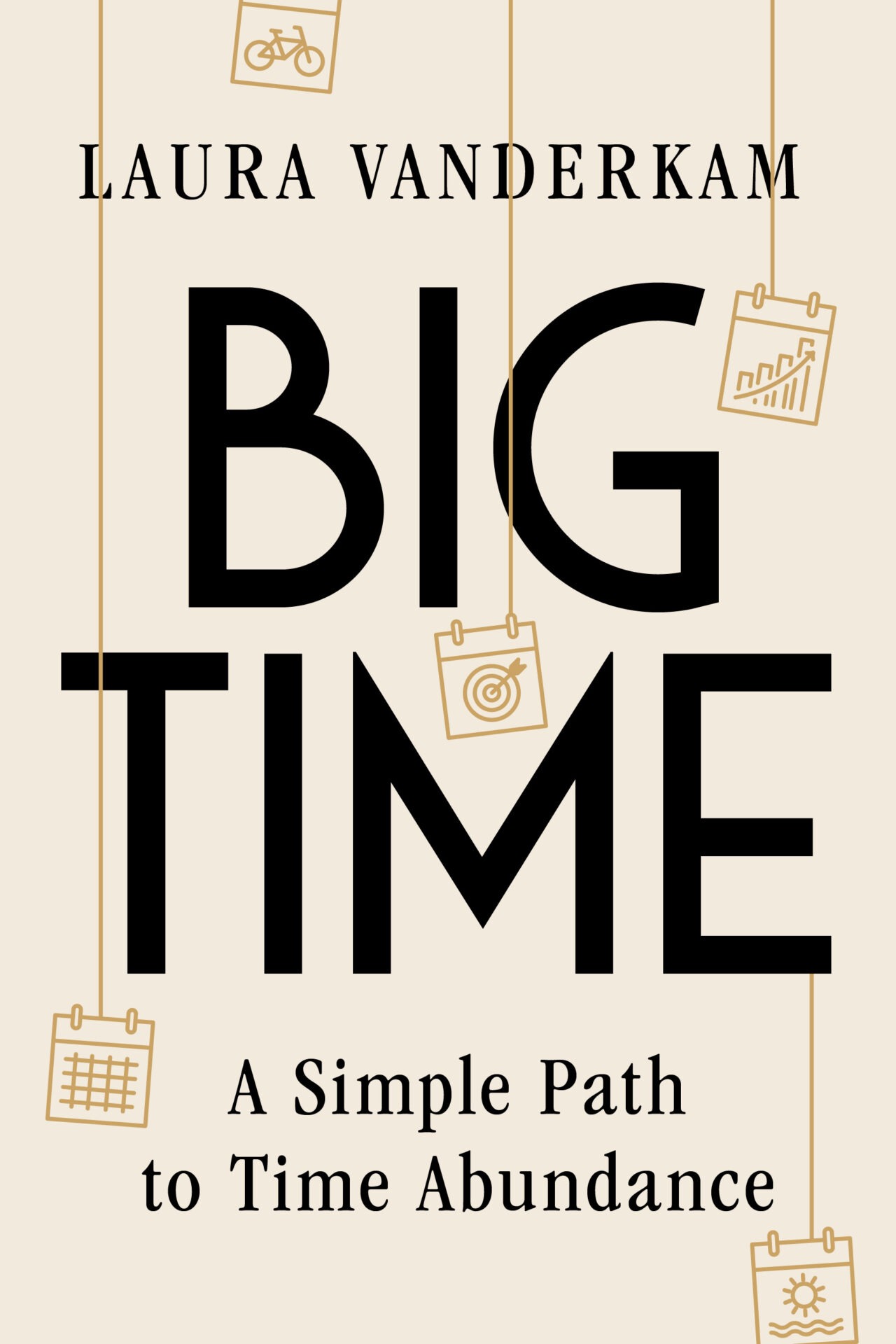
I couldn’t wait to get my hands on a copy of Laura’s most recent book, Big Time: A Simple Path to Time Abundance, released in North America on May 5th. Unfortunately, publication in Europe comes a bit later, but she graciously sent me a digital copy.
It came with no strings attached. She didn’t ask me to mention the book on my blog, and when I told her I planned to, she certainly didn’t tell me what to say. Without further ado, here are some thoughts on Big Time.
It was, as expected, a delightful read.
I adore Laura’s writing style. For lack of a better word, I find it calming. Or, in the words of the Wall Street Journal, “her approach is gentle and reassuring.”
Yup, that’s it!
She’s efficient in life and writing—she has five kids and manages a busy career as a time management expert, so I’d expect nothing less—but her books never feel rushed. There’s a coziness to them. My Danish sister-in-law would probably call it hygge.
It certainly felt that way as I cuddled up on a chilly May day (in Finland, spring feels suspiciously winter-adjacent) reading about subtle reframes I can use to approach how I spend my days, weeks, months, and years.
Laura’s books never make me feel bad about how I’m currently spending my time. Thank goodness; I’m all too familiar with reading something from the self-improvement genre and feeling like I need a complete life overhaul.
She offers a uniquely expansive approach to time management. She rarely advocates cutting things out of life entirely. Instead, she encourages saying yes to things that excite us, questioning clichéd narratives about time scarcity (I admittedly fall into this trap), and making small but meaningful adjustments that compound over time.
That’s one of my favourite things about her philosophy: she assumes real life exists. Kids, fatigue, obligations, unpredictability, laundry, chronic health conditions. The answer isn’t perfection, it’s building slightly better defaults. (I suspect she’d pipe up and add that investing in good childcare helps, too!)
If the title didn’t give it away, her latest book focuses on a concept she terms “Big Time.” She gently recommends discarding some of the go-to excuses about how cramped and hectic our schedules are and recognizing that, when we zoom out, there is almost certainly room to make time for more of the activities that make life feel rich.
Given the current state of my days, I couldn’t help drawing comparisons to executing a months-long trip around Europe with two kids. It decidedly feels like choosing the bigger life, rich with adventure and opportunity.
It also requires… a lot of effort.
I nodded when I read this line: “All magic is just labor, hidden well.”


When I post about gorgeous gondola rides in Venice or fairy-tale churches, there’s a tremendous amount of invisible labour happening behind the scenes. Planning, logistics, schlepping children across countries while everyone is overtired and thirsty.
But it’s worth the effort.
Laura doesn’t frame meaningful experiences as effortless. She acknowledges that most worthwhile things require effort. For instance, she assumes readers are familiar with the time vortex of smartphones and suggests a little workaround: spending a few minutes reading an e-book before allowing mindless scrolling through Instagram.
She writes: “Most likely, you’ll keep reading the book because effortful fun is, in fact, fun, once you overcome the initial resistance.”
So many of the best parts of life are wonderful precisely because they require something of us. In that effort, we realize time—and people—are valuable. Exchanging our limited hours for something worth the effort (reading a book, calling a friend, volunteering at a soup kitchen, planning a trip, going to a writing workshop) often ends up feeling far more memorable than whatever easy distraction we might have defaulted to instead.
That said, Laura has tracked her time closely for years and keeps things realistic:
“I wasted a lot of time in 2024, and I did a lot, because 8,784 hours is a lot of time. I spent gobs of time on pointless things and it was one of the most productive years of my life. Many things that seem contradictory are in fact perfectly compatible when viewed from a broader perspective.” [Emphasis mine.]
This pushes back against my own belief that every moment has to be optimized in order for life to feel meaningful.
That’s categorically false!
I can waste time and still have an incredibly productive year. (Though, to be fair, what constitutes wasted time? A few hours spent mindlessly daydreaming about trip destinations or Googling random trivia or watching silly cat videos can be a lot of fun, even if it doesn’t feel particularly virtuous.)
I can be ambitious and restful. Structured and spontaneous. Serious about my work while also protecting space for personal pursuits.
Another section that stayed with me was her discussion about saying yes to opportunities before you know where they’ll lead. (Moving to Europe for almost 4 months, anyone??)
She talks about her reticence to swim with sharks, an experience her teenage son was especially keen to try. Well, she swam with sharks—and, spoiler alert, survived the experience—and then unexpectedly passed a pod of whales on the boat ride back to shore, which provided a magical end to the day.
In her words: “‘Yes’ makes possible a great many things.”
“Big breaks and big opportunities tend to come from saying yes to something that’s not in the normal run of show….It’s hard to see where a given thread will lead, professionally or personally. Life is full of serendipity—roughly defined as finding wonderful things you aren’t actively looking for.”
My friend Joy, who could win an award for the world’s most generous heart, offered to take in two cats for the people staying in our house while we’re in Europe. (I’m terribly allergic, so it wouldn’t work to have them at our place.) Pet-sitting hasn’t been without a few bumps along the way, but her family has fallen in love with the cats and cat ownership may be in their future… all because she said yes.
Another friend, Sophie, is an academic researcher in Australia. She also happens to have two young children. In other words, her life is extremely busy. Yet instead of simply plodding along through the never-ending list of work and home responsibilities, she’s currently away on a week-long fiction masterclass taught by a bestselling author. It may open exciting doors. At the very least, it’s giving her a chance to invest in a creative pursuit she genuinely loves.
More than anything, you get the sense Laura wants people to create a life they find exciting. Yes, adult routines can feel like drudgery. But if you do the math, each week contains 168 hours. Even after you account for work, trips to the grocery store, tackling the laundry pile, and sleep, there is usually quite a bit of flexible time left over (especially if you’re honest about how you’re spending those flexible hours).
Many of us have far more autonomy over our days than we think.
“In general, you want to spend less time on things you need to talk yourself into…Instead, look for ideas or possibilities that you start talking yourself out of… The initial excitement is telling. Everything else is logistics. You’ll probably figure it out.”
I closed the book and started to think: what am I excited to see on my calendar?
Not: what seems impressive. Not: what is merely sensible. (If nothing else, I’m sensible; perhaps that’s why my daughter thinks I give off a Laura Ingalls vibe in both clothing choices and personality.)
What genuinely energizes me before practicality starts giving its little speech?
That framing alone made Big Time worth reading.
From broad-picture ideas (taking an hour each week to work on something professionally that interests you) to practical decisions that make everyday life more enjoyable: “You can make sure your kids’ bookshelves are curated with stories you enjoy, hiding such monstrosities as The Giving Tree up on the top shelf.” (Feel free to reach out to Laura directly if you happen to love Shel Silverstein.)
Throughout the book, Laura also weaves recurring encouragement to trust yourself. Trust that you can follow through on the life you’re trying to build. So many goals fail not because we lack ambition, but because somewhere along the way we stop believing ourselves when we make commitments.
One of the most practical reminders in the book also happens to be one of the simplest: “Twenty minutes a day, if it’s truly daily, is about 120 hours in a year—the equivalent of taking three weeks off work to devote to your goal, without actually having to do that.”
That’s classic Laura! Tiny tweaks, done consistently over time. (It also seems like a good cousin to my beloved Three times a week makes a habit.)
And perhaps that’s ultimately why her books are so comforting to me. They don’t demand a completely different life. They simply ask me to participate more intentionally in the one I already have.

I started writing blog posts three times a week. Now, I post almost daily and have a community of friends from around the world. I’ve spent a weekend hanging out with Laura’s co-host on Best Laid Plans, Sarah, and met blogging friends Sophie, Kyria, Suzanne, Birchie, Kae, and Catrina, with more fun meetups on the horizon.
As Laura puts it in Big Time:
“Putting big and worthwhile things into a schedule actually makes you feel like you have more time, because in your mind, you become the kind of person who has the time to do big and worthwhile things.”
Big and worthwhile isn’t a static definition. The goal isn’t to squeeze more into life for the sake of productivity, but to create a life expansive enough to hold the people and activities that matter most.
GIVEAWAY

Laura and I would love to send one lucky reader a signed copy of Big Time: A Simple Path to Time Abundance.
To enter, simply leave a comment below. Bonus points if you answer the following question: What would you like to do with 20 intentional minutes a day?
(Or, I’ll also accept your thoughts on what children’s book should be banished to the top shelf!!)
I’ll choose one winner at random over the weekend (I’m not nailing down a specific time because I have family visiting starting tomorrow!) and will announce the winner next Monday, 18 May.
Discover more from The Optimistic Musings of a Pessimist
Subscribe to get the latest posts sent to your email.


I’ve already had the pleasure of reading Big Time, so don’t need to be entered in the draw.
How should I spend 20 extra minutes in my day? Easy. Exercise.
How do I WANT to spend 20 extra minutes in my day? Sleeping.
Extra 20 minutes – would spend it on practicing Indian classical dance. I recently started learning it at the age of 44 while dealing with an autoimmune condition. Love the art form and want to practice more of it
Banish The Rainbow Fish to the top shelf.
Oh, I really like that phrase “effortful fun”. That’s exactly how I experience running: it takes effort, but it also feels genuinely good while you’re in it.
I also like Laura’s core message here. Time abundance isn’t about squeezing more in, it’s about what you repeatedly choose. That shift is simple, but quite powerful.
I do hope the copy ends up with a mum who is juggling too much and rarely gets proper time for herself!
Having recently revamped my life’s plan to care for a family member, I would spend those twenty minutes relaxing by drawing. Also let’s banish The Giving Tree.
I’ve been listening to Best of Both Worlds for a few years now, but I only recently started reading Laura’s books and I was blown away. When I picked up 168 Hours last fall, I assumed that it would be a variation on “get up at 4AM and stop watching TV”, which was not the case at all. I love the focus on prioritizing the good stuff.
I know when I started listening to BOBW – it was the fall of 2023 and the episode theme was that there were 100 days left in the year so it was a perfect time to pick a goal to knock out before the end of the year. That’s when I started my “pushup snack” habit!
Now that I’m retired I’m (almost) completely in charge of my time and my entire focus is on doing things that I want to do. So what’s my 20 minute project to add on top of that? Piano!!! I’ve completely gotten away from practicing. I don’t want to spend hours a day playing, but I do want to bring back my little roster of tunes, and 20 minutes a day is the perfect amount of time to make that happen.
Birchie, what is your “pushup snack” habit? My guess is that anytime you reach for a snack, you make yourself first do a pushup. Even if that’s not it, seems like a good idea!
I DEFINITELY want to read this book!!! I love the BOBW podcast- you truly get the feeling that Laura (and Sarah) really want everyone to be living their best lives.
It’s been a while since I’ve read childrens books… but one that comes to mind is Silverlicious. The one where Pinkalicious loses a tooth and is waiting for the tooth fairy… it just goes ON AND ON. Reading it before bed turns into 30 minutes of tedium.
I really want to learn to sew this year! Knowing me I would likely spend an additional 20 minutes in my day reading, but I already do a ton of that. Sewing is something I want to pursue and I’m sure if I devoted 20 minutes to it a day I would be at least a moderate sewer by the end of the year!
I love that framing – just 20 minutes a day! It’s so doable!
I would like to start reading more regularly. After a back injury it was hard to find a good position to relax and read so I got out of the habit. But now the injury is mostly healed, I want to get back to it!
Thank you!
I would like to devote 20min a day to babying my house plants. They are often neglected.
I love this giveaway — it feels like blogging did 15-20 years ago! 🙂 I already take the time to workout/walk, puzzle, and read often, so I would probably choose nap {oh that sounds lovely!} or get back into cross stitching like I did with my mom and grandma as a kid!
I got a headstart by accident: this year I am reading through the entire Bible, following The Bible Recap plan. I’ve read through before, and it was a real slog. This time is different: 12 minutes of reading, and 8 minutes of listening to an explanation of the day’s segment. 20 minutes a day!
Life is full of shoulds: instead of looking for excuses to not exercise, I SHOULD just make sure to fit in 20 minutes a day, whether or not someone meets me for a walk. I SHOULD actually use the pair of handweights collecting dust over there. I SHOULD write a note to someone whenever a nice thought about them pops into my head. I SHOULD wash my car (definitely more than 20 minutes) regularly. I SHOULD . . . .
What lights my fire? I want to be left entirely alone to read in peace and quiet. I’ve never read Laura Vanderkam but after reading this review, I am definitely interested in what she has to say!
With 20 minutes – I’d love to start drawing again to break up my day sitting at my desk in front of a laptop. Maybe even draw outside to get some Vitamin D! I love Laura’s books and I’m sure I would enjoy reading this one too.
Hi, thanks for the great, honest review of the book. I am a retires empty nester and I would like to give it to my daughter-ion-law.
I would love to spend an extra 20 minutes a day decluttering or just resting and reading, or working on my embroidery project. I can think of a multitude of things!
I’d love to spend an extra 20 minutes a day reading in bed with my kids at night. 🙂
Thanks for the opportunity to win!
I would LOVE to win Laura’s book! I’ve had a lifelong affliction of perceived time scarcity, and would love to learn time abundance from Laura. I want to get back into meditating 20 minutes per day…your comment that 20 minutes a day means 120 hours per year really motivates me to to include it in my daily schedule.
20 extra minutes? Lots of things I could do but I would pick getting rid of 3 things a day. =)
I used to really prioritize letter writing & people tell me they keep my letters. I’d like to restart that habit for 20 minutes a day. 🙂
This book sounds fantastic!
I would banish Robert Munsch books to the top shelf. I really dislike them
Love this review and also have a shared appreciation for Laura’s work! With 20 minutes a day, I’d like to go on more walks with loved ones….SO…. I stopped reading this post and texted my dad who is retired. I have to prep for a big meeting next week and I asked him to meet me at a trial between our houses to walk and listen to my practice presentation! I’m so pleased with this plan. It will be a fun Throw back to speech and debate days. 😊
I’d banish all the children’s books about creepy artists like Picasso and Degas, especially the one where Degas chooses the little girl to be his model. Ick. Would love to read Laura’s latest book!
Hello! With 20 extra minutes, I would plan out and make a cohesive and yummy meal rather than just throwing something together!
Hi! With 20 extra minutes, I would drink my coffee and eat breakfast at home instead of at work!
What a great review! I’m looking forward to reading this newest installment of Laura’s- her style is always inspiring in a very realistic and accessible way.
Twenty minutes a day might look like extra reading or more deliberate time for written reflection. I do tend to fly by the seat of my pants when life gets stressful and reflection helps keep me grounded. Or dedicating time to music – singing or piano. Definitely things I love but often neglect making time for.
I would definitely guilt freely walk around the neighborhood and talk to NO ONE 🙂
Love this review and now I can’t wait to read this book. I love all of Laura’s books but I did wonder what the new angle was in this one, now I know. Thanks for the shout out too! With an extra 20 minutes a day – that’s easy – I’d write fiction in a quiet house. And the books I’d hide would be any Dr Suess when I’m tired haha.
Oh I would love to be entered if I can, especially because it’s not yet out here as you noted :-). I feel my life actually has too many 20 minute slots at random times, so I probably need to figure out what I intentionally should do with them. I guess if I had a guaranteed extra 20 minutes every day I would do a 15 minute yoga video every day, which would take me 20 minutes because that’s how time works for me.
The Giving Tree is awful. I have a 1950s book called “we help mommy” about kids helping their mom clean house, which we keep because it’s from the 50s but also it makes me somewhat sad to realize 76 years ago any cleaning was “helping mommy” – I guess dad didn’t need a clean house???
I’ve been able to make time for some of the things that bring me joy (and health) like reading and exercise. I think my next 20 min/day is going to be spent being more deliberate about meal planning and prep. This likely involves a little daily planning time as well – which I think will also add benefit. I’d love a chance to read the book, but will check my library too!
I will play to enter! I would say….gosh, it’s hard, because I feel like there are a lot of daily type things I’d like to do, well, daily, but it’s hard to fit them ALL in. I’d love to play the piano for 20 minutes every day. Blog 20 mins EVERY day. READ MORE (this is the one I tend to skimp on the most….). I’d like to spend 20 minutes a day working on my photo project (going back and wedding out all my old pics from pre-cloud photos and transferring them to the cloud!). I’d also love to spend 20 min a day working on my past vacations blog posts, that’d be fun. Ooh, 20 min a day of yoga and stretching! I could see using my hot tub for 20 minutes a day, too. 20 minutes a day learning a new skill… like, cooking new recipes, or learning to knit!, or could I be a puzzle person?? Hmm. Haha. SO MANY IDEAS, lol!!
I try to read a book on my Kindle for 20-30 minutes each evening before going to sleep, but that only ends up happening 50ish% of the time. One reason for that is when the battery gets low, I have to remember to take it downstairs to charge, which I typically forget about by morning. But I sleep much better when I read vs. when I play Candy Crush for those 20 minutes!
I loved 168 hours, look forward to reading this! I could definitely do with 20 minutes of yoga/stretching each day. I’m good at doing the hard exercise stuff, but my body (and mind) really benefit when I also do the slower stretching and breathing work.
Sorry if this is a duplicate.
I would probably want to spend it exercising or writing.
This book sounds great!
I’d probably use an extra 20 minutes sleeping haha. The other options would be reading or working on the cross stitch that I’m in the middle of.