

You know I love any excuse to talk about language. Give me all the discussions about spelling, pronunciation, and idioms. If it’s quirky and has a good backstory, I’m in.
So you can imagine my delight when I stumbled across hurkle-durkle, a new-to-me term, a few weeks ago:
Hurkle-durkle (verb): To linger under the covers of a warm bed long after it’s time to get up.
It’s cozy, lazy, and a little rebellious. It’s also of Scottish origin. (Which happens to be my lineage on both sides.)
Hurkle-durkling is the fine art of knowing you technically should get out of bed… and deciding the world can wait a little longer.
What Does Hurkle-Durkle Mean?
The Dictionary of the Scots Language states: “to lie in bed or lounge about when one should be up and about.”
The should is important.
Going to bed at night is not hurkle-durkling. Sleeping when you are meant to be sleeping is just… sleeping.
Hurkle-durkling happens after you wake up. Maybe the alarm has gone off?! Maybe sunlight is streaming in through the curtains. Hopefully someone else is unloading the dishwasher with enthusiasm (definitely not either of the children in my household).
You are awake and you know the day has started.
And yet!!! You remain horizontal.
Maybe you read a few pages of a book. Maybe you drink coffee in bed. Maybe you stare into space and enjoy the fact that no one currently requires you to locate their missing socks (or insert any other item that children could possibly lose which IS EVERYTHING).
You are not asleep.
You’re hurkle-durkling!!
Where Did Hurkle-Durkle Come From?
Hurkle-durkle is an old Scots expression, not a phrase invented by TikTok, though social media has helped introduce it to a new generation.
The Dictionary of the Scots Language traces the phrase back to a Scottish dictionary published in 1825.
I’m fascinated by the idea that 200 years ago, people already needed a specific word for refusing to get out of bed.
Technology changes and clothing changes and even language changes… but human beings apparently remain equally reluctant to leave warm blankets.
The older Scots word hurkle can refer to crouching down or drawing the body together, which feels fitting. Hurkle-durkling naturally involves curling oneself into the smallest possible shape while pulling the covers up around one’s ears.
Hurkle-Durkle vs. Hygge
My Danish sister-in-law has taught me so much about Scandinavian coziness, including the fact that sipping a mug of hot coffee while nibbling on homemade ginger cookies as snow falls outside makes for a very, very hygge afternoon.

Hygge—the Danish concept of coziness and contentment—has become a household word. Hygge is about creating warmth and comfort; hurkle-durkling is about refusing to leave it.
I think the two make an excellent pair.
Hygge might involve candles, homemade cookies, and a roaring fire.
Hurkle-durkling might involve tangled hair, yesterday’s pyjamas, and pretending you can’t hear the rest of your family beginning their day.
If hygge is about making the world feel cozier, hurkle-durkling is about giving yourself full permission to stay horizontal and let the world wait.
Is Hurkle-Durkling the Same as Bed Rotting?
Hurkle-durkling sounds similar to the more modern concept of “bed rotting”—spending a long stretch of time lying in bed, often while scrolling, watching television, or doing absolutely nothing.
But I don’t think they feel the same. (Granted, this distinction is hardly scientific, do don’t quote me.)
Bed rotting sounds bleak and endless. Hurkle-durkling feels whimsically intentional and definitely more cheerful. You enjoy a lazy morning, eventually throw back the covers, and decide when to rejoin civilization.
Bed rotting says: I live here now. Hurkle-durkling says: I’ll be up soon. (Probably.)
How Do You Use Hurkle-Durkle in a Sentence?
Hurkle-durkle is technically a verb, so you can use it in several ways:
- I planned to get up at 7:00, but I hurkle-durkled until 8:00.
- Saturday morning is prime time to hurkle-durkle.
- Please don’t schedule anything before 10:00 am. I intend to hurkle-durkle.
In my opinion hurkle-durkling is a perfectly reasonable way to describe the activity and I’m voting in favour of hurkle-durkler as the term for someone who participates.
The Joy of Hurkle-Durkling
Hurkle-durkling feels like a small act of joy.
Or defiance.
(Or both.)
We live in a culture that tends to applaud motion. Get up early! Start the day strong! Be productive! Make the bed immediately! Lift weights in your basement while you listen to an audiobook in a different language! Apparently, everyone successful is awake before dawn, drinking lemon water and completing a complicated exercise routine.
Meanwhile, some of us (OKAY, ME!) are blinking at the clock and negotiating for five more minutes.
After spending an entire Year of Shmita thinking about rest, I’ve become increasingly interested in the concept of deliberate restoration.
Not every moment has to be optimized.
Sometimes it’s okay to stay under the covers a little longer simply because the bed is warm, the morning is quiet, and you can.
Obviously, there are mornings when the alarm rings and responsibilities demand immediate action. Life does not always leave space for leisurely horizontal rebellion.
But when the opportunity presents itself, I say hurkle-durkle away.
Your turn.
- What’s your favourite obscure word or idiom — the weirder, the better!
- Are you a proud hurkle durkler, or are you up with the birds?
- What’s your ideal lazy morning setup? (Books? Tea? Breakfast in bed?)
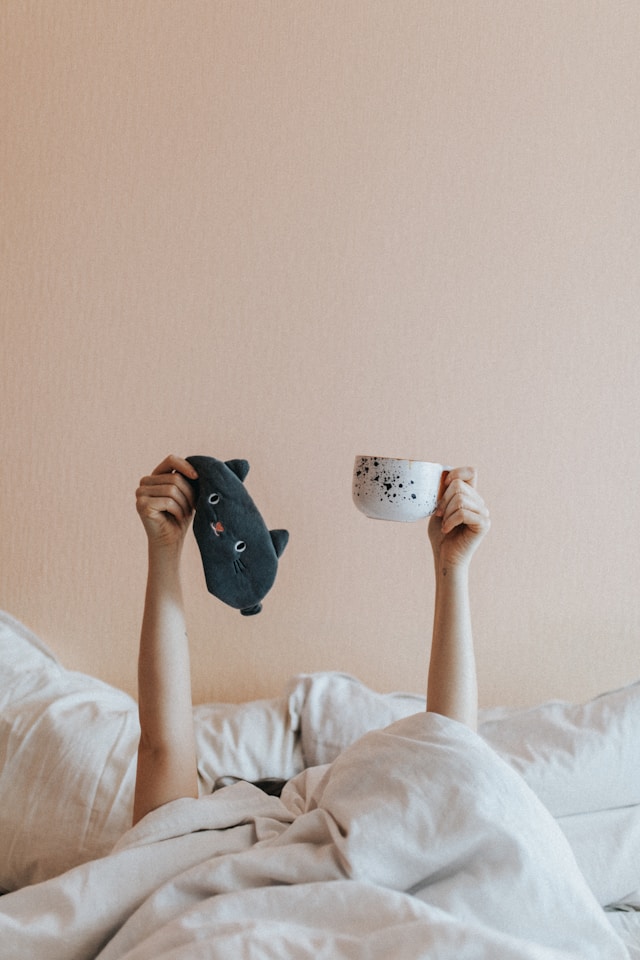
Header photo by Taisiia Stupak on Unsplash
Discover more from The Optimistic Musings of a Pessimist
Subscribe to get the latest posts sent to your email.


That’s great. The Scottish have some fun words. I was reading about hiking in Scotland and came across this one: stravaig. It means to wander aimlessly or casually. It’s not really my style but I like the sound of the word! I’m more of a get to your destination kind of girl.
That does NOT sound like Kyria, but what a helpful word. My kids are very good at stravaig. I’m in between. John is also a “let’s get there” type of walker.
I don’t know if it’s obscure, but perambulate is fun to say. Concatenation too.
I rise with the birds. But I’m curled up on the couch in a soft blanket right now ( waiting for time to get up and starting my morning routine) so maybe a modicum of hurkling here? I do like waking up just a little bit before I have to, so I can have quiet time to myself – books and word games. I used to stay up late to do this, but my daily rhythm has shifted.
Perambulate is a very satisfying word to say! I’ve never heard (or at least I didn’t recognize it) concatenation. I love learning new things like this. Question is, will I remember the definition??
I do not wake up well. Sigh. I wish I was a “fly out of bed with excessive energy.” In general, I’m just low energy at most times. I can function and have a great time, but I am rarely energetic. It takes all kinds in the world, right?
Do you listen to the Inside out Money podcast? They spent a whole episode talking about hurkle durkling recently! I love to hurkle durkle, and I love that word. A funny word we use a lot is “Schmuddlefink” my grandparents are German and I grew up hearing this word and now use it often in my own household! It means, roughly, “little naughty grub ball”, which is a perfect word to describe kids in my opinion!
I don’t listen to that podcast, but now I’m curious.
Little naughty grub ball! Ha.
This reminds me a bit of the Portuguese form of endearment: batatinha pintada, which translates to “little painted potato” which makes no sense, but it’s a sweet phrase and I sometimes use it to describe my kiddos.
I was born just north of Edinburgh and spent my early childhood there – so yes, “hurkle durkle” is part of my vocabulary! I don’t use it often though.
In our family, “blether” (talking rubbish), “crabbit” (grumpy), and good old “tatties” for potatoes are still in regular use. And the more I think about it, the more words come flooding back. You’ve sent me down a path of nostalgia!
Ohhhh! Someone who actually grew up using this term. How did it take nearly 40 years for me to hear it for the first time. I like hurkle durlking!
I would say blather in the same way you say blether! I’ve never heard this alternate spelling (and maybe it means slightly different things)?
Crabbit inherently SOUNDS very grumpy!
WELL. As soon as I saw the title of this post, I thought “I’ve never heard of hurkle durkle, but whatever it is, I’m in!” And then I read the definition. Who doesn’t like a good hurkle durkle? Unfortunately, I can’t hurkle durkle on weekday mornings- my alarm goes off and I have to get right up. But… I know what I’m doing on Sunday!!!
Yay! You can now claim your Sunday mornings as prime time to hurkle durkle.
Hurkle durkle! I have never heard of that and I have a lot of Scottish blood. I am not a hurkle durkle person though, I am generally up and at it.
I love how the Australians nickname everything – from uni to mozzies to sunnies.
I wish I was up and at it. *Sigh* Is it genetic? Like, are your parents morning people? Is Rob a morning guy? Do you wake him up by rising so early. I AM CURIOUS!
I try so hard, but after a few days (or at most weeks) of early mornings and I feel like death.
Never heard that one, but it’s a good one!
I love this! I’ve also recently discovered “hurkle durkle” and it is such the perfect word. I am a big fan of hurkle durkling and all things cozy 🙂
One of my other favorite words you never knew you needed is the German word “fernweh” (literally “farsickness”), for that feeling of being homesick for somewhere I’ve never been. And in double-checking my spelling, I’ve just discovered there’s a Welsh term that is a perfect “partner” for that: Hiraeth
Ohhh. Fernweh! That is perfect and so true. I love how other languages often have words that perfectly describe a feeling. (So often it’s German, too!)
My mother was a Scot and, you know what, I’ve never heard this saying before, ever! Is it from a particular area of Scotland? Dang, now I have to go jump down a rabbit hole and find out for myself.
I have to say the Scots and the Irish do have some great sayings. As for hurkle durkling myself? I have to be up before 8am to take pills every morning, so no, I don’t really get a lay in as such. And no breakfast in bed for me.
I’ve always found German words to be funny, and love the word for rabbit: Kaninchen (a long story).
Let me know what you find down your rabbit hole. I just spotted it in a magazine (not sure which) and it struck my fancy.
I love words, and hurkle durkle is a good one! I’d never heard it before now. I don’t hurkle durkle very often. As soon as I’m awake, I want all the morning breath and eye crusties gone, so I get up right away. Every once in a while, I’ll sneak back into bed after taking care of those things, but more often, once I’m up, I’m up.
I wish I had a good word along these lines!
I wish I didn’t enjoy hurkle durkling so much, Michelle. I am not a morning person (in fact, I generally just wish I was in bed reading a book at most points in the day). So I think your early morning routines are admirable.
How fun!
I’ve not heard of hurkle durkler. I do enjoy staying cozy in my bed after I wake up. It rarely happens. I usually pop up and get ready to workout before babies get dropped off for my daycare. Once a few months ago, I woke up on a weekend and had no place to be and a book that I loved, and I read in book for a while. I’m sorry I have no fun words to add, but in my daycare we sing a little song I made up when Lad was a baby. ‘Nigh-Nigh, the baby’. It’s caught on. With the older kids, if someone yawns or acts cranky, then that person can expect an impromptu singing of Nigh-Nigh the baby.
I love when families have inside jokes, sayings, or songs (we have MULTIPLE “family” songs). It really adds to feeling at home and makes for a unique connection.
I set my alarm early so I can hurkle durkle every morning, hah. I need that hurkle durkle time to wake up and to motivate myself to get out of bed!
I guess if I want to hurkle durkle on week days I need to set an alarm. I just hate waking up SO MUCH.
I had not heard of this word/phrase! I am not a hurdle durkler! Phil is, though. He tends to sleep later than me so if I wake up, I go elsewhere so I don’t disturb him. But my kids prevent any sort of slow start to the day, esp Will who yells loudly for us when he is up for the day. Will would like to be a hurkle durkler on week day mornings, though!!
I remember the years of early wakeups. They were awful. For someone like me that is not a morning person, having a very loud, child who wanted up and needed things IMMEDIATELY upon getting up was such a slog. I am in awe of anyone who has survived that stage more than twice.
And, like Will, IF my kids were going to sleep in it was only ever going to be on a day I needed them to get up in a timely manner. Now, my kids sleep in. It’s glorious. Except school mornings are getting harder…
Great word. Words are so fun. I love to use “prolly”, “liberry”, “remorial”, “tryna”, and “horriblize”.
(Interpretations: probably, library, memorial, trying to, catastrophize.)
One of my kids always used to call is “liberry” and dessert was “Baa-zert”. Those were the days.
I really like horriblize! I find catastrophize such a hard word to pronounce.
This is my Saturday morning tradition! I have a cpuple cups of coffee and read in bed while everyone else gets up.
Love it!
I have never heard this term but it is one of my absolute favourite things to do, and most mornings that I don’t need to work (aka Tue/Thur/Sat/Sun) I absolutely do it for as long as possible! We got a new set of microfiber sheets last year and they are just the right texture (soft but feel cool and smooth) and I love to just snuggle down and read my book before officially starting the day. Love that there’s a word for it, and what a fun word to boot!
One of my favourite words is “pulchritude” or “pulchritudinous”, which refers to beauty, but the word itself sounds like the opposite. I also love the word “glaucous”, which refers to the powdery coating on the outside of a grape. And somnambulant, which maybe isn’t obscure, but is just such a fun word to say.
A few Italian words have made it into our family lexicon: “basta!” (enough), “andiamo” (let’s go), and “pipistrello” (which means bat, as in the flying mammal — we see them in the evenings in our back yard and it’s especially fun to say with an exaggerated Italian accent!) I always love your linguistic posts — keep them coming!
Okay, you take the cake for cool words! I’ve seen the word glaucous, but had no idea what it meant!
Saying words in other languages can be such a hoot, especially when an accent it involved!
I’ve heard the term, but I don’t know that I’ve ever used it.
I love this ‘in action’ though and I refer to it as Linger Longer. I love to linger in bed if there isn’t anything calling me….especially if my husband brings me a hot cup of coffee, that along with two sleeping pups? Why do I need to get up and ruin all of those delightful senses?
I don’t have dogs, but the image of relaxing in bed with a cup of coffee (I DID NOT PREPARE) with two sleeping pups sounds like the absolute best thing in the world.
Linger Longer. Love it.
What a fun discovery. I had not any idea there is a word for that but apparently the Scottish knew it first. So fun. Thanks for sharing.
I have not yet commented on your other post on words but I am currently going down a linguistics rabbit hole – in my personal AND work lives – and LOVING it. I am starting to think I should have studied linguistics. 🙂 So I love everything about this post.
Pennsylvania Dutch is fabulous for great words – it’s a mishmosh of German and English, still spoken by the Amish and Mennonite folks who live in PA Dutch country. But of course, now, I cannot think of words off the top of my head! Here’s a great link on Wikipedia. Rutsch is one my family used (to squirm), as well as Doppich (klutzy). Dippy eggs was something my friends say and you see it at restaurants. 🙂 https://en.wikipedia.org/wiki/Pennsylvania_Dutch_English