

Last month I read Make Believe: On Telling Stories to Children by Mac Barnett. It’s a tiny book about the magic of storytelling and reading for pleasure.
I wanted to share a few quotes as it relates to fiction. They really made me think!
I don’t know why I didn’t tell those kids, “Oh, no, I’m not really a spy. That’s just a story I tell.” Honestly, it never even occurred to me. I didn’t want to tell the truth. And I think I understood on some deep level that the kids didn’t want me to either. We were entering into the bargain all fiction writers make with their readers: The writer says, “I’m going to tell you a lie.” And the reader says, “Okay, I will believe it.” Samuel Coleridge, the English Romantic poet and critic, called this contract “that willing suspension of disbelief.” Kids just call it make-believe. [Emphasis mine.]
I’d never thought of fiction as a form of lying but, in a way, it is. And I loved the idea of entering into a contract with the writer. I’ll tell you a lie. You’ll agree to believe it.

Another section in the book made me SO happy.
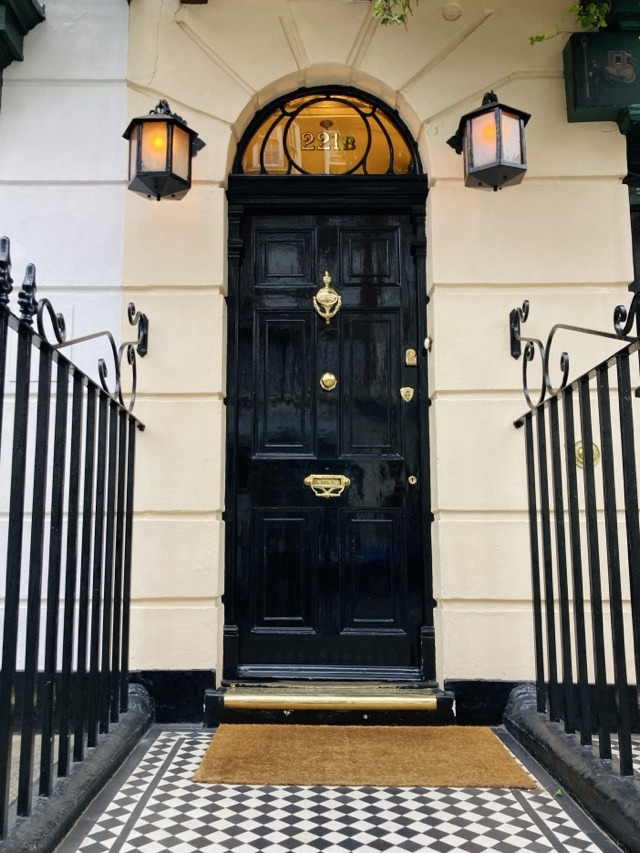
At the end of our only full day exploring London, Belle and I made an extra effort to visit 221B Baker Street. It ended up being somewhat inconvenient, but we both agreed we were SO glad we’d gone.
I grew up watching Jeremy Brett as Sherlock Holmes and have read all of Arthur Conan Doyle’s stories featuring this famous detective, so it was a special stop for me.
Barnett writes:
When we read, we make believe. We aren’t duped or ensorcelled. Deep down we decide. We make ourselves believe. We know the characters in stories aren’t real, but our feelings for them are. We know the things in the stories never happened, but we can’t wait to learn what happens next. It’s make-believe when adults take a photo in front of 221B Baker Street, the London address of Sherlock Holmes, which is marked by a plaque, installed in 1990, between 237 and 241. These people don’t care that Sherlock Holmes is a fake detective or that (and I’ve double-checked my math on this) 221 is not a number between 237 and 241. They’re making believe… So is the reader who says, about the characters in a favorite series, “I feel like these people are my friends,” or the one who finishes a long novel and keeps saying sadly, “I’m just going to miss living in that world.” [Emphasis mine.]
Sure enough, when Belle and I showed up on the doorstep of 221B Baker Street, there was a man dressed in Sherlock Holmes garb. And he asked us to take his picture!

One final quote…
When we celebrate children’s literature, we must avoid the trap of utilitarianism. Claims that books will improve kids’ behavior, enhance their emotional development, or raise their test scores may be true, but they inevitably end up limiting the ambit of children’s literature. Art need not be useful. A children’s book is not a tool. Champions of kids’ books should always be wary of sunny appeals to futurity: “We are making lifelong readers! Shaping future readers! Molding model citizens!” Yes, okay, sure, the children are the future; in twenty years, more people who are currently kids will be alive than people who are currently adults. But the children’s writer—and anyone who gives books to children—would do better to think about children in the present. Kids are human beings right now, with rich interior lives. They deserve entertaining stories and meaningful art. [Emphasis mine.]
“Art need not be useful.“
I’d argue that art—including literature—is inherently useful simply by virtue of being beautiful, stirring our emotions, or sparking our imaginations.
Not everything needs to serve a practical purpose. Not every book needs to teach us something. Sometimes the experience of reading a great story is enough.
And I especially appreciated this reminder: “Kids are human beings right now, with rich interior lives.”
In other words, they shouldn’t have to wait until adulthood to “deserve” good stories and meaningful art. They’re entitled to those things today.

Your turn:
- Have you ever visited a place associated with a fictional character?
- Have you ever finished a book and felt genuinely sad to leave its characters behind?
- What was your favourite book as a young reader?
Discover more from The Optimistic Musings of a Pessimist
Subscribe to get the latest posts sent to your email.


